The digital marketing landscape is undergoing a profound transformation, moving beyond traditional Search Engine Optimization (SEO) to embrace Answer Engine Optimization (AEO). As generative Artificial Intelligence (AI) permeates search interfaces, brands are racing to adapt their content strategies to secure visibility in these new, conversational environments. Groundbreaking research from HubSpot’s “State of AEO 2026” report and Wix Studio’s “AI Search Lab” offers critical insights into the content formats most favored by large language models (LLMs) across platforms like ChatGPT, Gemini, AI Overviews, and Perplexity. These studies, collectively analyzing over a million AI citations, provide a data-backed roadmap for content creators seeking to thrive in the AEO world.
The Dawn of AEO and the Content Imperative
The rise of generative AI has fundamentally altered how users seek and consume information. Instead of a list of blue links, users increasingly receive synthesized answers, often accompanied by citations to the source material. This shift necessitates a re-evaluation of content creation, focusing not just on ranking, but on being cited by AI. AEO is the discipline of optimizing content to be easily understood, extracted, and referenced by these AI-powered answer engines. The stakes are high: securing a citation means direct visibility and implied authority within the AI’s response, a powerful endorsement that can drive traffic and build brand trust.
HubSpot’s “State of AEO 2026” meticulously analyzed thousands of citation themes between December 2025 and March 2026, while Wix Studio’s “AI Search Lab,” powered by Peec AI, indexed over a million citations across 75,000 AI answers. These independent datasets converge on similar conclusions, painting a clear picture of what resonates with AI. The findings suggest that success in AEO hinges on a multi-layered approach, combining specific content formats with intent-matched title patterns and citation-correlated structural elements.
Decoding AI’s Preferences: Top Content Formats Revealed
![On-page content formats answer engines actually favor [new research]](https://53.fs1.hubspotusercontent-na1.net/hubfs/53/best-on-page-content-formats-for-ai-1-20260525-6914910.webp)
The research unequivocally points to a select group of content formats that consistently earn high citation rates across various AI platforms. Overall, listicles, articles (or blog posts), product pages, and category pages emerge as the most cited content types. Intriguingly, comparison content stands out as a particular favorite for ChatGPT, boasting an impressive 95% citation rate—the highest recorded for any format on any engine.
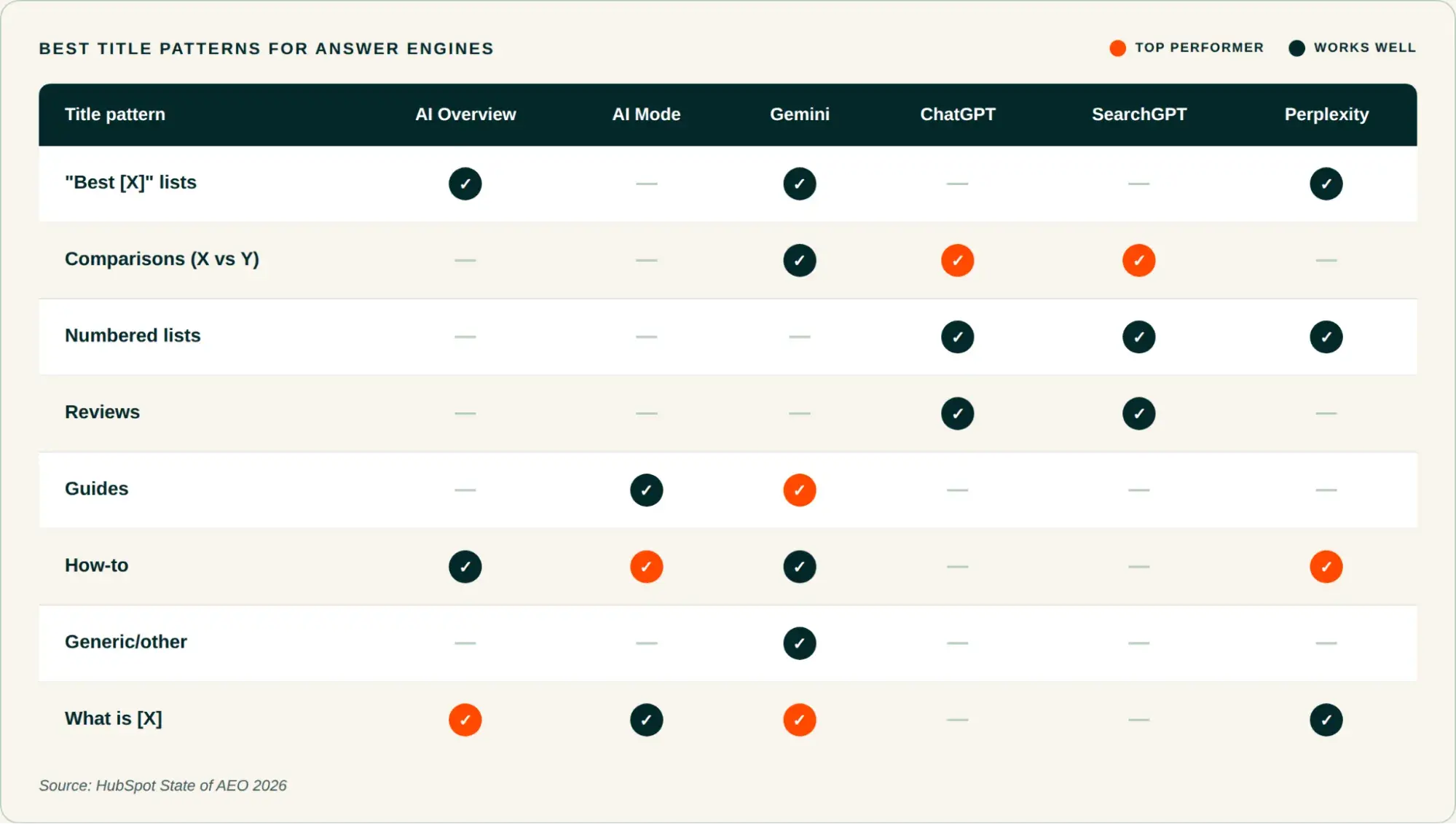
- Listicles: These ranked or numbered lists proved to be the most cited content type in Wix Studio’s cross-engine data, accounting for 21.9% of all citations and a staggering 40.86% of citations on commercial queries. The “Best [X]” or numbered list title patterns perform strongly across AI Overviews, Gemini, Perplexity, ChatGPT, and SearchGPT.
- Articles/Blog Posts: Defined as informational long-form content (e.g., “What is X” explainers), articles lead citations in AI Overviews (42% citation rate) and Gemini (76%) according to HubSpot’s report. Wix Studio’s analysis further supports this, showing articles account for 45.48% of citations on informational queries. They are the safest cross-engine bet when the user’s primary intent is to understand a concept.
- Product Pages: For transactional or navigational queries, product listings and landing pages are highly effective. HubSpot’s data shows an 84% citation rate for these pages on Perplexity, the highest for any format on that engine. Wix Studio’s analysis places product pages at 13.7% of all AI citations, concentrated heavily in transactional (24.88%) and navigational (21.95%) contexts.
- Category Pages: Wix Studio identifies category pages as a distinct and highly cited format, capturing 11.3% of all AI citations. Their visibility is particularly strong in navigational (18.31%), transactional (14.97%), and commercial (12.42%) queries, with even higher rates in ecommerce and home repair sectors.
- Comparison Content: HubSpot’s “State of AEO 2026” highlights comparison content as a powerhouse, especially for ChatGPT, where it achieves an unmatched 95% citation rate. Title patterns like “X vs. Y” are top performers for both ChatGPT and SearchGPT.
It’s important to note a nuance regarding Perplexity: this engine exhibits a significant preference for third-party discussion content (e.g., Reddit, G2, LinkedIn, Quora), which accounts for 17.35% of its citations—more than double the cross-engine average. For brands targeting Perplexity users, an off-site discussion strategy runs parallel to on-page optimization efforts.
The Architecture of Trust: Why LLMs Favor Certain Structures
LLMs do not “read” pages in the human sense. They process tokenized chunks of information, often weighting content unevenly. Research from Stanford documented a U-shaped accuracy curve, indicating that LLM performance can suffer when relevant information is buried in the middle of long inputs. This means the structure of content is paramount for predictable extraction and accurate summarization.
- Predictable Extraction: Consistent headers, short, digestible sections, and front-loaded answers ensure that crucial information is positioned where LLMs are most likely to process it effectively. A 2026 GEO-SFE preprint found that structured formats like lists and tables significantly improve LLM extraction accuracy (43% better than prose). This highlights why formats like listicles, with their clear itemization and distinct sections, perform so well.
- Citation Signals and Authority: Beyond mere extractability, LLMs also look for signals of trustworthiness and authority.
- Schema Markup: Implementing schema types such as Article, HowTo, FAQPage, or ItemList provides crawlers with immediate context about the page’s purpose, aiding interpretation. While not a guaranteed citation booster, it’s considered good SEO hygiene.
- Visible Last-Updated Dates: Signals recency, ensuring the AI references the most current information.
- Author Bios: Establishes credibility and expertise behind the content.
- Declarative Claims with Verifiable Facts: Provides models with language they can directly lift and attribute.
- FAQ Sections with Schema: These directly address natural-language questions, making content highly relevant for conversational AI. The GEO-SFE preprint noted that structural changes alone could yield an average 17.3% citation lift across generative engines without altering the content’s meaning.
These elements combine to form what HubSpot identifies as three layers influencing AI citations: the content type, an intent-matched title pattern, and citation-correlated structural elements.
Strategic Content Design: Matching Intent with Format
![On-page content formats answer engines actually favor [new research]](https://no-cache.hubspot.com/cta/default/53/9dd5e54b-fbef-4dd0-bc44-1689feb1ea18.png)
The Wix Studio research succinctly states, “User intent is the strongest predictor of which content types get cited.” Therefore, content strategy must begin with aligning the buyer’s intent to the optimal format.
-
Informational Queries (“What is X?”, “Why does X happen?”):
- Content Type: Long-Form Articles / Explainer Blog Posts.
- Title Pattern: “What is [X]?”
- Structural Must-Haves: Comprehensive definitions, historical context, clear explanations of complex concepts, relevant statistics, expert quotes, an author bio, and a well-structured FAQ section with schema markup.
- Likely Wins: AI Overviews, Gemini.
-
Commercial Queries (“Best [X]”, “Top [N] [X]”, “[X] tools”):
- Content Type: Listicles / Best-of Posts.
- Title Pattern: “Best [X]” or numbered lists.
- Structural Must-Haves: Numbered H2s/H3s using brand names (e.g., “HubSpot CRM”), concise descriptions of each item, clear pros/cons, pricing information, comparison points, visible last-updated dates, and a concluding call-to-action (CTA).
- Likely Wins: AI Overviews, Gemini, Perplexity, ChatGPT.
-
Comparative Queries (“[Brand A] vs. [Brand B]”, “Is [X] better than [Y]?”):
- Content Type: Comparison Articles.
- Title Pattern: “[X] vs. Y.”
- Structural Must-Haves: Side-by-side comparison tables, clear differentiation points, feature breakdowns, pricing contrasts, user reviews, decision-making criteria, and a visible last-updated date.
- Likely Wins: ChatGPT, SearchGPT.
-
Transactional/Navigational Queries (“[Brand] [product name]”, “[Brand] [feature name]”):
- Content Type: Product and Landing Pages.
- Title Pattern: Product or feature name.
- Structural Must-Haves: ItemList or Product schema, concise product descriptions, detailed specifications in tables, clear feature lists, customer testimonials, pricing details, and a prominent call-to-action.
- Likely Wins: Perplexity, and all engines for direct navigational queries.
-
Category Exploration (“[Category] tools”, “[Category] software”):
![On-page content formats answer engines actually favor [new research]](https://53.fs1.hubspotusercontent-na1.net/hubfs/53/best-on-page-content-formats-for-ai-2-20260525-5829990.webp)
- Content Type: Category Pages.
- Title Pattern: Category name.
- Structural Must-Haves: ItemList schema, clear definition of the category, curated product or service listings, filtering options, and brief, informative descriptions for each listed item.
- Likely Wins: Perplexity, and strong for commercial queries across engines.
-
Procedural Queries (“How to do X”):
- Content Type: Step-by-Step Guides.
- Title Pattern: “How to [X].”
- Structural Must-Haves: Numbered steps, clear instructions, screenshots or visual aids, and HowTo schema.
- Likely Wins: Google AI Mode, Perplexity.
Optimizing Existing Assets for the AEO Landscape
Given the extensive volume of legacy content, optimizing existing pages is often the fastest path to AEO success. Structural updates alone can significantly boost citation rates by leveraging existing organic equity.
The 5-Step Quick Audit:
- Identify High-Value Pages: Focus on pages that already rank well in traditional search or address critical buyer intents.
- Match Intent and Format: Ensure the page’s content type aligns with the primary user intent it serves (e.g., a “what is” page should be an article, not a listicle).
- Check Title Patterns: Verify that the meta title and H1 accurately reflect the intent-matched title patterns (e.g., “Best X,” “X vs. Y”).
- Implement Structural Elements: Add or refine key elements like an introductory TL;DR, consistent H2/H3 hierarchy every 150-200 words, a descriptive FAQ section with schema, visible last-updated dates, and author bios.
- Chunk Long Paragraphs: Break down dense blocks of text into more digestible formats like bullet points, numbered lists, or shorter sentences.
Making Content “Chunkable”:
Long, unbroken paragraphs are detrimental to LLM extraction. Restructure them by:
- Introducing a new H2 or H3 every 150-200 words to create logical breaks.
- Converting lists within prose into bullet points or numbered lists.
- Breaking long sentences into two or three shorter, more direct sentences.
- Front-loading key information in the first sentence of each paragraph.
Universal Structural Elements: Beyond format-specific templates, several structural elements apply to nearly every page, making content easier for answer engines to understand and summarize. These include:
![On-page content formats answer engines actually favor [new research]](https://53.fs1.hubspotusercontent-na1.net/hubfs/53/best-on-page-content-formats-for-ai-3-20260525-9814874.webp)
- A clear H1 that precisely matches the buyer’s intent.
- An immediate TL;DR summary at the top.
- A logical H2/H3 hierarchy throughout the content.
- A comprehensive FAQ section with FAQPage schema.
- A visible “last-updated” date.
- An author bio.
- Strategic internal links within topic clusters.
Internal Links and Topic Clusters: A well-structured topic cluster with a pillar page linking to subtopic pages, and cross-linking between related content, is crucial. Google’s guidance on internal links emphasizes their role in guiding both users and crawlers. For AEO, this means a robust internal linking strategy makes your site more crawlable, improves AI’s understanding of your content relationships, and increases the likelihood of your pages surfacing across the “fan-out” queries AI systems use to assemble responses.
Measuring Success and Sustaining Visibility in AI Search
Optimizing for AEO is an ongoing process that requires diligent measurement and governance. Content format changes are only valuable if they lead to measurable improvements.
AI Visibility Tracking: Baseline metrics across ChatGPT, Gemini, and Perplexity include:
- Citation Rate: The percentage of queries where the answer engine cites at least one of your pages.
- Share of Voice: Your brand’s proportion of total citations for a given set of prompts.
- Brand Visibility Score: A composite score reflecting your brand’s overall presence and prominence in AI answers.
Tools like HubSpot AEO automate this tracking, providing visibility scores and competitor benchmarks.
Page-Level Performance Mapping: AI visibility doesn’t automatically translate to revenue. Marketers must map each optimized page to its conversion role (e.g., demo signups, content downloads). Since referrer data from AI engines can be incomplete, proxy signals like shifts in branded search volume and direct traffic can help attribute AI-driven engagement.
Reporting Cadence: Establish a monthly baseline check for tracked prompts and a quarterly deeper review. Weekly score tracking and trend alerts from AEO tools can help marketers react quickly to changes.
![On-page content formats answer engines actually favor [new research]](https://53.fs1.hubspotusercontent-na1.net/hubfs/53/best-on-page-content-formats-for-ai-4-20260525-9253081.webp)
Content Governance Model: Sustaining AEO wins requires a clear governance framework. Assign ownership for content clusters, defining review cadences and update triggers. Common triggers include a drop in citation share, a competitor entering an AI answer, or major model releases from OpenAI, Google, or Anthropic. A robust internal QA checklist before republishing ensures content remains fresh and optimized.
Effective Refresh Tactics: Focus on updating elements that directly carry citation signals:
- The title and introductory summary.
- Statistics and data points.
- The FAQ section and associated schema.
- The visible last-updated date.
- The author bio and credentials.
Future Forward: Adapting to the Evolving AI Ecosystem
The landscape of AI search is dynamic, requiring continuous adaptation. While schema markup is recommended for good hygiene, it’s not a magic bullet; it must accurately reflect page content. Content refresh frequency should be event-driven rather than strictly time-based, triggered by citation drops, competitive shifts, or new AI model releases.
A critical consideration for publishers is managing AI crawler access. Major AI companies offer separate bots for training versus live search. For instance, blocking GPTBot prevents OpenAI from using content for training, while allowing OAI-SearchBot ensures continued eligibility for ChatGPT’s live web search citations. Similarly, Google-Extended can be blocked to opt out of Gemini training, while Googlebot remains active for traditional search indexing. Careful management of robots.txt directives is essential.
Ultimately, the starting point for AEO optimization should be driven by dominant buyer intent. If informational queries prevail, articles are key. For comparative intent, comparison posts. For commercial intent, listicles. By building upon existing organic equity and aligning content strategy with proven AI preferences, brands can secure a leading position in the evolving world of answer engine optimization. Tools like HubSpot’s AEO Grader and Marketing Hub Pro+ offer invaluable support, using CRM data to inform prompt suggestions and ensuring AEO efforts remain anchored to core business objectives. The future of search is conversational, and successful content will be that which speaks most clearly and reliably to AI.