

The rapid integration of artificial intelligence into the digital marketing landscape has brought forth a wave of new tools and protocols promising to revolutionize how professionals manage and report on campaigns. Among these, the Model Context Protocol (MCP) has emerged as a significant development, enabling AI assistants like Claude to interact directly with external data sources. However, a critical distinction must be made: while MCP significantly streamlines ad-hoc data retrieval and internal analysis, it is not a replacement for a robust client reporting system. Understanding the nuances of MCP, native platform capabilities, and data warehousing solutions like BigQuery is paramount to delivering accurate, insightful, and client-ready reports.
Defining the Model Context Protocol (MCP)
At its core, MCP stands for Model Context Protocol. In simpler terms, it is a standardized method that allows AI assistants, such as Claude, to connect with and retrieve data from external tools and data sources. An MCP server acts as the intermediary, facilitating these connections. For instance, one MCP server might be configured to access Google Ads data, another for Google Analytics 4 (GA4), and yet another for BigQuery.
This protocol offers a significant advantage over traditional methods. Instead of manually exporting data in CSV formats, opening multiple browser tabs, and then painstakingly pasting numbers into a chat interface, an AI powered by MCP can directly request specific data from the connected system. This capability is particularly beneficial in the realm of Pay-Per-Click (PPC) advertising, where reporting questions often begin in an exploratory and less defined manner. A user might ask about changes in performance from the previous week, notice an anomaly, and then seek to understand the underlying reasons. MCP excels in facilitating this iterative, investigative process.
For PPC professionals, connecting an AI assistant to platforms like Google Ads or GA4 via an MCP solution, such as GoMarble, allows for direct querying of changes without the laborious steps of data export and pivot table construction. This expedites ad-hoc investigations and makes data exploration considerably faster than conventional methods. However, the misconception arises when this streamlined data retrieval is mistaken for a complete client reporting solution. Many professionals, upon connecting to a platform via MCP, assume they have solved their reporting challenges. While they have indeed made ad-hoc queries more efficient, generating client-ready reports demands a more comprehensive approach.
Leveraging Native Platform Reporting for Internal Account Management
For internal account management and preliminary checks, the native reporting capabilities within platforms like Google Ads are often sufficient. Google Ads provides a robust “Reports” section that covers essential aspects of campaign performance, including campaign movement, search term analysis, asset performance, and budget pacing, all accessible without leaving the platform. While perhaps not always utilized to its full potential, the introduction of AI-powered report generators within platforms, such as Google’s Gemini, further enhances these capabilities. These tools allow users to describe the desired report in plain English and have it automatically generated within the interface.

The accompanying screenshot illustrates this point, showcasing how Gemini is already automating much of the report-building process. When addressing internal account-specific questions, if Google Ads can provide a clear and concise answer, it should be the primary tool utilized. The true value of the combined AI, MCP, and BigQuery stack is realized when the questions require governed definitions, the integration of disparate data sources, or the generation of client-facing commentary.
The complexity arises when the data needs to be presented to a client. A client’s query typically extends beyond the scope of a single platform’s attribution model or reporting window. They are seeking an understanding of what has happened to their business, which often necessitates integrating data from multiple sources to provide a complete picture.
MCP for Exploratory and One-Off Investigations
Direct MCP connections prove highly effective for investigative and one-off queries. This type of work is inherently exploratory; the precise question is not always known at the outset. The process involves gathering context, following emergent threads, and posing follow-up questions. MCP handles this dynamic exploration efficiently, offering a faster and lower-friction alternative to downloading reports and attempting to manually align columns.
The strength of direct MCP lies in its suitability for disposable queries. The objective is to obtain an answer, not to create a permanent reporting asset. However, the limitation is that these queries directly interact with the platform. Google Ads reports on Google Ads data, and GA4 reports on GA4 data. Client reporting, however, often requires the critical “join” between these distinct data sets.
BigQuery: The Foundation for Reliable, Repeatable Reporting
For any metric that appears in a client report or influences critical budget decisions, it should not rely on an AI reconstructing its definition from a prompt each time. This is where solutions like Google BigQuery become indispensable. BigQuery provides the necessary “memory” for client reporting, ensuring consistency and accuracy.
Ingesting data into BigQuery is a straightforward process. Google’s native transfer services cover a wide range of data sources. For those seeking a lighter-weight solution, tools like Weavely can handle Google Ads and GA4 data with minimal configuration. Supermetrics is another option, particularly if it’s already part of a broader client data stack, though it may represent a higher cost than necessary for this specific use case in many accounts.

Once the data resides in BigQuery, the creation of “views” is the next crucial step. These views act as curated datasets, pre-defining the logic and structure for recurring reporting needs. This ensures that whatever is pertinent to the account is consistently defined and accessible in one central location.
A simple yet powerful example is the segmentation of brand versus non-brand campaigns. Google Ads may not always split this categorization in a manner that aligns with a business’s specific needs. By creating a BigQuery view, campaigns can be labeled according to a custom naming convention or an agreed-upon definition. This logic is embedded within the view itself. Consequently, when an AI, such as Claude, is asked about non-brand performance, it queries this view and retrieves a standardized answer based on the same definition used previously.
For those who find the term “BigQuery view” technically daunting, it can be conceptualized as a saved reporting logic. Instead of requiring an AI to remember and reapply a complex definition of “non-brand” for every query, the AI is provided with a clean, pre-defined table to access.
Beyond definitional consistency, there is a significant token cost argument in favor of BigQuery. When an AI queries a live platform via MCP, the raw API response, encompassing all campaigns, ad groups, and metrics for a given date range, is brought into the context window. This can be token-intensive and the data is ephemeral, disappearing at the end of the conversation. In contrast, when a query targets a BigQuery view, the AI receives a small, pre-aggregated result. The heavy computational lifting has already occurred within BigQuery, keeping token costs low irrespective of the underlying data volume.
The Synergistic Power of the Combined Stack
The practical implementation of this approach involves a synergistic combination of these technologies. The workflow typically looks like this:
- Data Ingestion: Raw data from sources like Google Ads and GA4 is consistently transferred into BigQuery.
- Data Transformation and Governance: Within BigQuery, views are created to standardize definitions, segment data (e.g., brand vs. non-brand), and aggregate key metrics. This establishes a “single source of truth” for critical reporting elements.
- AI-Powered Analysis and Reporting: An AI assistant, such as Claude, connects to BigQuery views. This allows for sophisticated analysis, the generation of client-ready reports, and the addition of insightful commentary.
- Client Deliverables: While some clients may still prefer traditional dashboards (which can be built from BigQuery data using tools like Looker Studio), a significant portion of client reporting can be delivered through clear, concise answers generated by the AI. These answers, based on governed BigQuery data, can be delivered on demand or on a scheduled basis, complete with commentary that accurately reflects the week’s performance.
To navigate this integrated system, a simple yet effective question can be posed to the AI itself: “Which of my reporting questions should stay in Google Ads, which are direct MCP checks, and which should be turned into BigQuery views?” This prompt often clarifies the necessary evolution of the reporting infrastructure.
The Simple Rule for Effective Reporting

The distinction between different reporting tools and methodologies can be distilled into a straightforward rule:
- One-off Questions: If a question is a single, exploratory query, leverage direct MCP for swift retrieval.
- Recurring Questions: If the same question is asked more than once, it’s a prime candidate for transformation into a BigQuery view. This ensures consistency and efficiency for repeated analysis.
- Client-Facing Data: Any data that is incorporated into a client report or influences significant business decisions must originate from governed data sources, ideally managed within BigQuery.
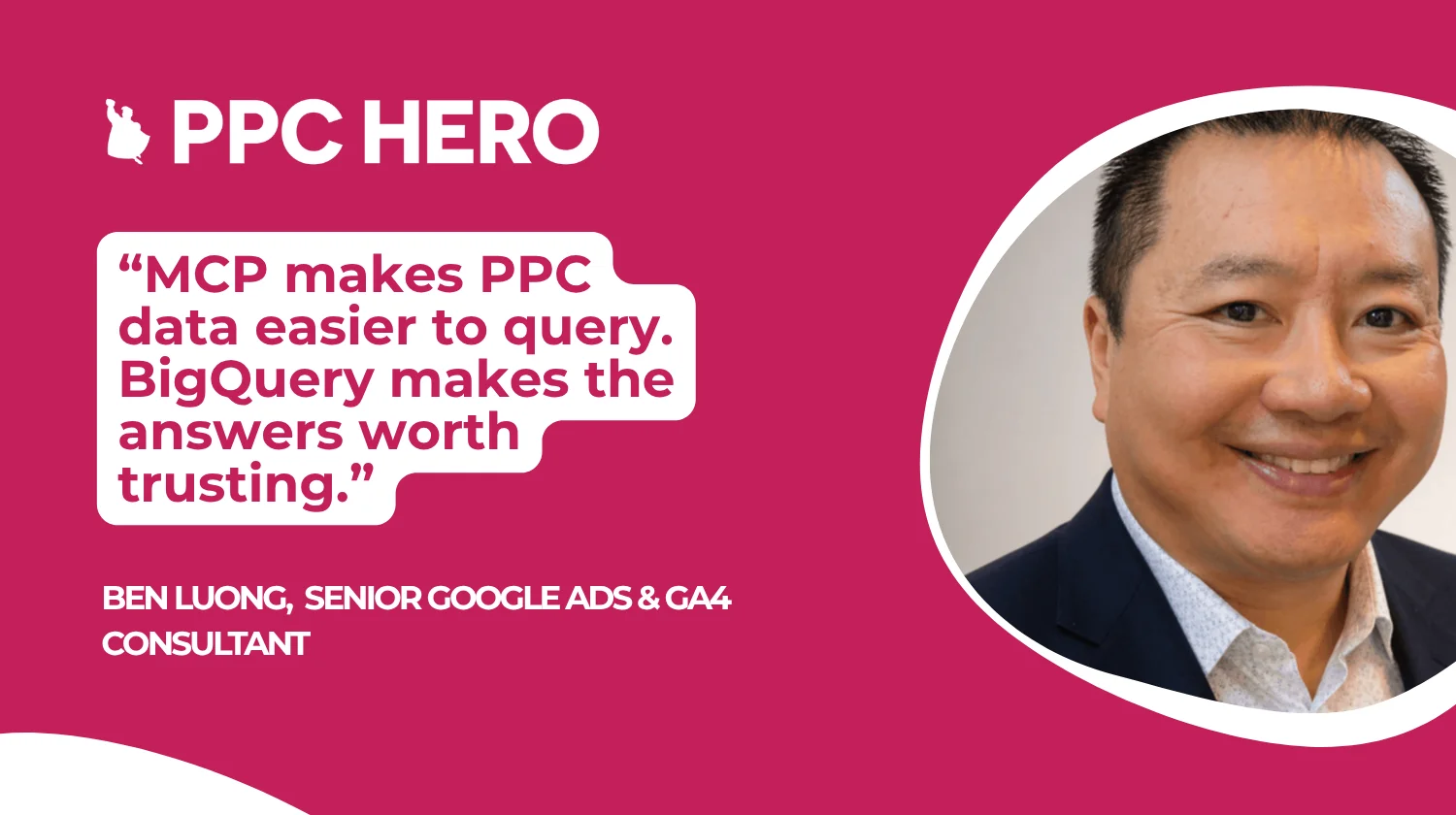
MCP fundamentally enhances the ease with which PPC data can be queried, unlocking faster access to raw information. However, it is BigQuery that imbues these answers with the trustworthiness and reliability required for impactful client reporting.
Broader Implications and Future Trends
The evolution from manual data manipulation to AI-assisted querying represents a significant paradigm shift in PPC reporting. By understanding and implementing the distinct roles of MCP and BigQuery, marketing professionals can move beyond simply reporting numbers to delivering actionable insights. This not only improves client communication and trust but also frees up valuable time for strategic analysis and campaign optimization.
The trend towards integrated AI-driven reporting is likely to accelerate. As AI capabilities mature and data infrastructure becomes more accessible, the ability to dynamically generate tailored reports with contextual commentary will become a standard expectation. The challenge for agencies and in-house teams will be to adopt these technologies strategically, ensuring that the pursuit of efficiency does not compromise the accuracy and depth of client reporting. The foundational principle remains: while AI can democratize data access, robust data governance and warehousing are essential for delivering reports that truly drive business outcomes. The future of PPC reporting lies not in a single tool, but in a harmonized ecosystem where AI, efficient querying protocols, and a reliable data backbone work in concert.









