rifanmuazin
The digital advertising landscape reached a significant milestone in 2024, as paid search advertising generated $102.9 billion in revenue within the United States alone. This figure solidifies search as the premier digital advertising format, accounting for approximately 39.8% of all digital ad revenue. The sustained growth of this sector is driven by a singular, powerful value proposition: the ability to place a brand in front of a consumer at the precise millisecond of declared intent. As the industry moves into 2025, with global spend forecasted to reach $355.10 billion, the complexity of the search auction and the necessity for sophisticated post-click strategies have become the primary differentiators between profitable campaigns and wasted capital.
While the scale of the market is immense, the barriers to entry and the cost of inefficiency are rising. Industry benchmarks indicate that the average cost-per-lead (CPL) has climbed from $66.69 in 2024 to approximately $70.11 in 2025. This inflationary trend in the digital auction house means that marketers can no longer rely solely on high bids to secure dominance. Success in the modern era of Search Engine Marketing (SEM) requires a multi-faceted understanding of auction mechanics, algorithmic campaign structures, and the psychological alignment of the post-click experience.
The Architecture of the Modern Search Auction
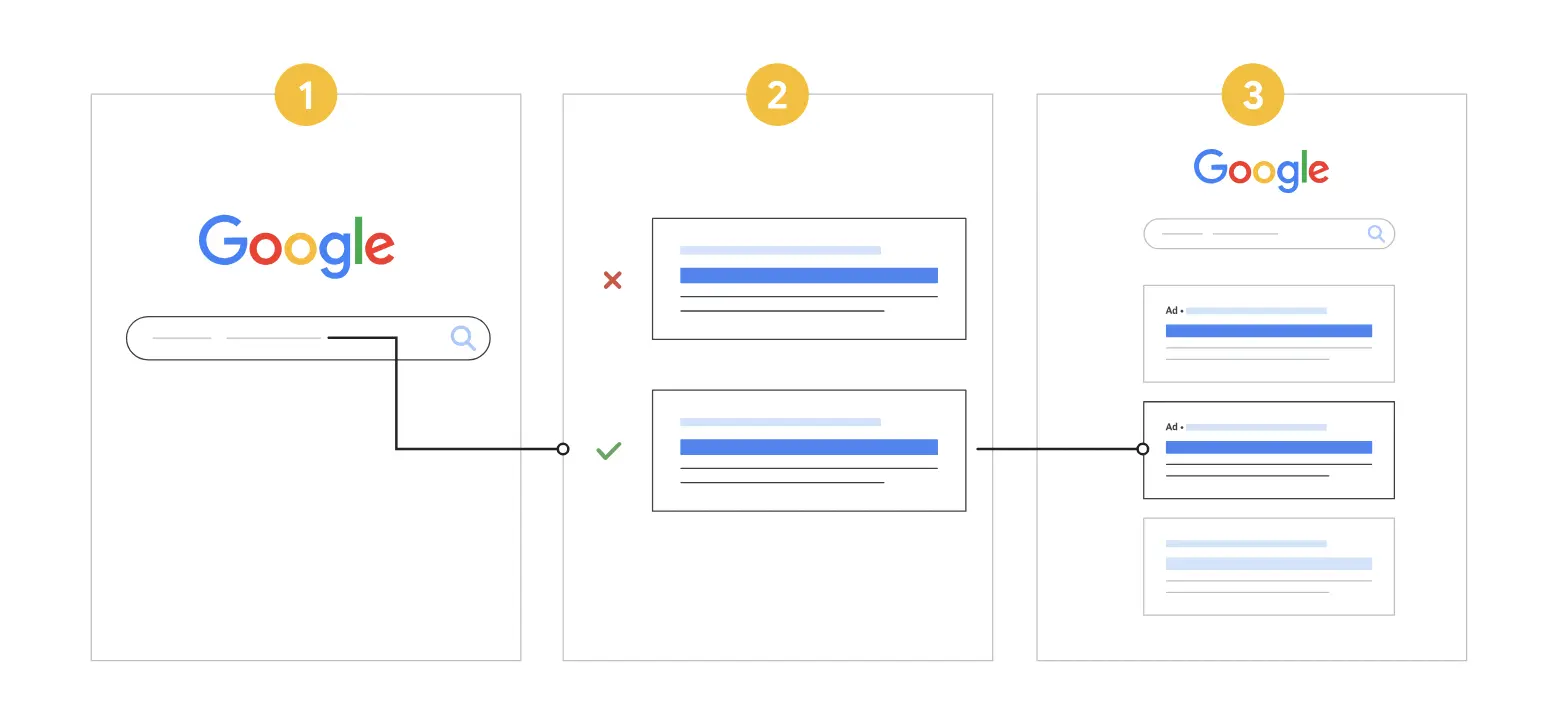
Paid search operates through a real-time, automated auction that occurs every time a user executes a query on a search engine like Google or Bing. Unlike a traditional auction where the highest bidder simply wins, the search auction utilizes a second-price model influenced by a “Quality Score.” This ensures that the most relevant, rather than just the wealthiest, advertisers reach the user.
The process begins when a user enters a search query. The search engine immediately identifies advertisers bidding on keywords relevant to that query. To determine the order of the ads (Ad Rank), the system evaluates the Maximum Cost-Per-Click (CPC) bid alongside the Quality Score. The Quality Score is a composite metric based on the expected click-through rate (CTR), the relevance of the ad copy to the searcher’s intent, and the quality of the landing page experience.
A critical nuance of this system is the “Actual CPC” calculation. An advertiser does not necessarily pay their maximum bid; they pay the minimum amount required to maintain their position above the competitor immediately below them, typically the lower bidder’s Ad Rank divided by the winner’s Quality Score, plus one cent. This mechanism incentivizes advertisers to improve ad relevance and landing page performance, as a higher Quality Score can effectively lower the cost of a top-tier placement.

The Competitive Landscape: Google, Microsoft, and the Rise of Niche Search
Google Ads remains the undisputed titan of the industry, commanding roughly 90% of the global search market. Its ecosystem extends beyond the Search Engine Results Page (SERP) to include YouTube, Gmail, and the Google Display Network. However, the landscape is diversifying. Microsoft Advertising has carved out a significant niche, particularly in corporate environments where Bing is the default search engine. The Microsoft network, which includes Yahoo, AOL, DuckDuckGo, and Ecosia, offers access to a demographic that is often older and possesses higher disposable income. Furthermore, Microsoft’s exclusive partnership to provide the ad-supported tier for Netflix represents a new frontier for search-style targeting in a streaming environment.
Simultaneously, Apple Search Ads has become an essential channel for the mobile economy. By allowing developers to bid for the top spot in App Store search results, Apple has created a high-intent channel that bypasses traditional web search for app discovery. For modern advertisers, a diversified approach across these platforms is increasingly necessary to mitigate the rising costs found on Google’s primary SERP.
Strategic Framework: From Keyword Research to Campaign Launch
Executing a high-performing paid search campaign involves a rigorous eight-step process designed to align business objectives with algorithmic requirements.
Phase 1: Goal Setting and Keyword Intelligence
Campaigns must be rooted in specific outcomes, whether that is brand awareness, lead generation, or direct e-commerce sales. Once goals are established, keyword research identifies the “language of the customer.” Keywords are generally categorized by intent:
- Informational: “How to manage projects” (High volume, low conversion).
- Navigational: “Asana login” (Specific brand intent).
- Commercial: “Best project management software” (Comparison phase).
- Transactional: “Buy Asana subscription” (Ready to purchase).
Phase 2: Mastering Match Types and Negative Keywords
To control spend, advertisers must utilize match types effectively. “Exact Match” provides the most control, while “Phrase Match” allows for some flexibility. “Broad Match,” while offering the greatest reach, requires a robust list of “Negative Keywords”—terms for which the ad should not show—to prevent budget bleed on irrelevant queries.
Phase 3: The Shift to Automated Creative
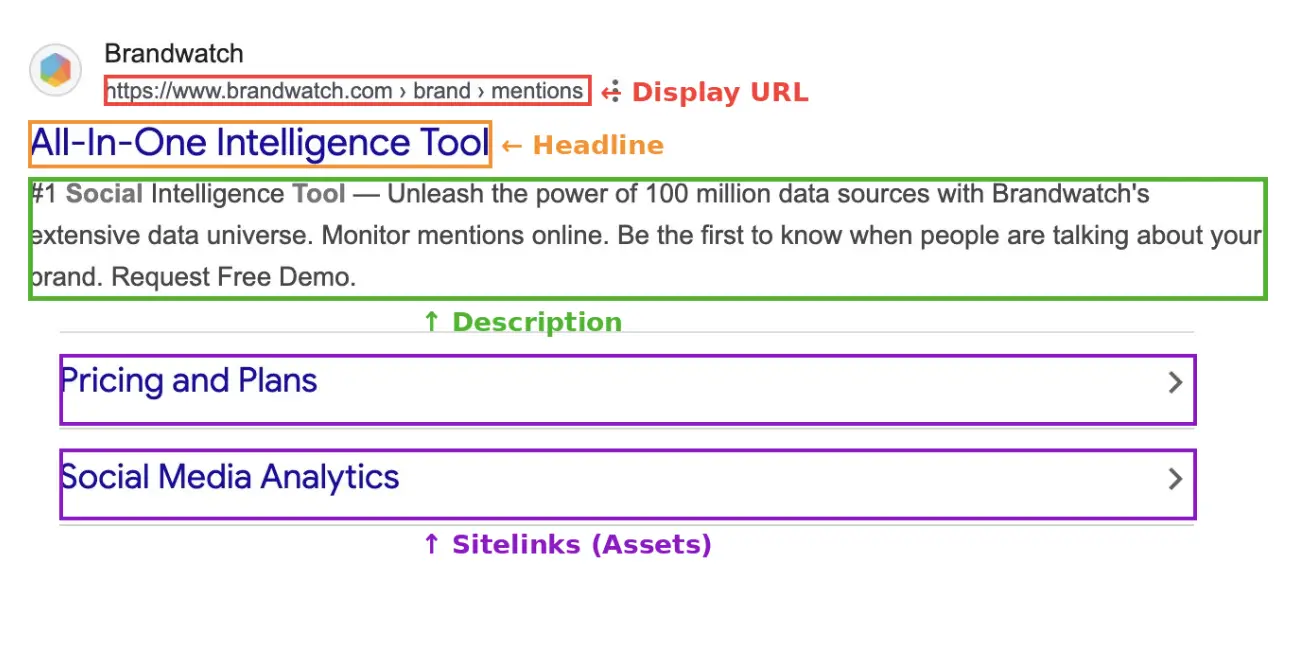
The industry has moved away from static text ads toward Responsive Search Ads (RSAs). In this format, advertisers provide multiple headlines and descriptions, and Google’s machine learning assembles the most effective combination for each individual user. This shift places a premium on creative diversity and the ability of AI to predict user resonance.
Phase 4: Smart Bidding and Performance Max
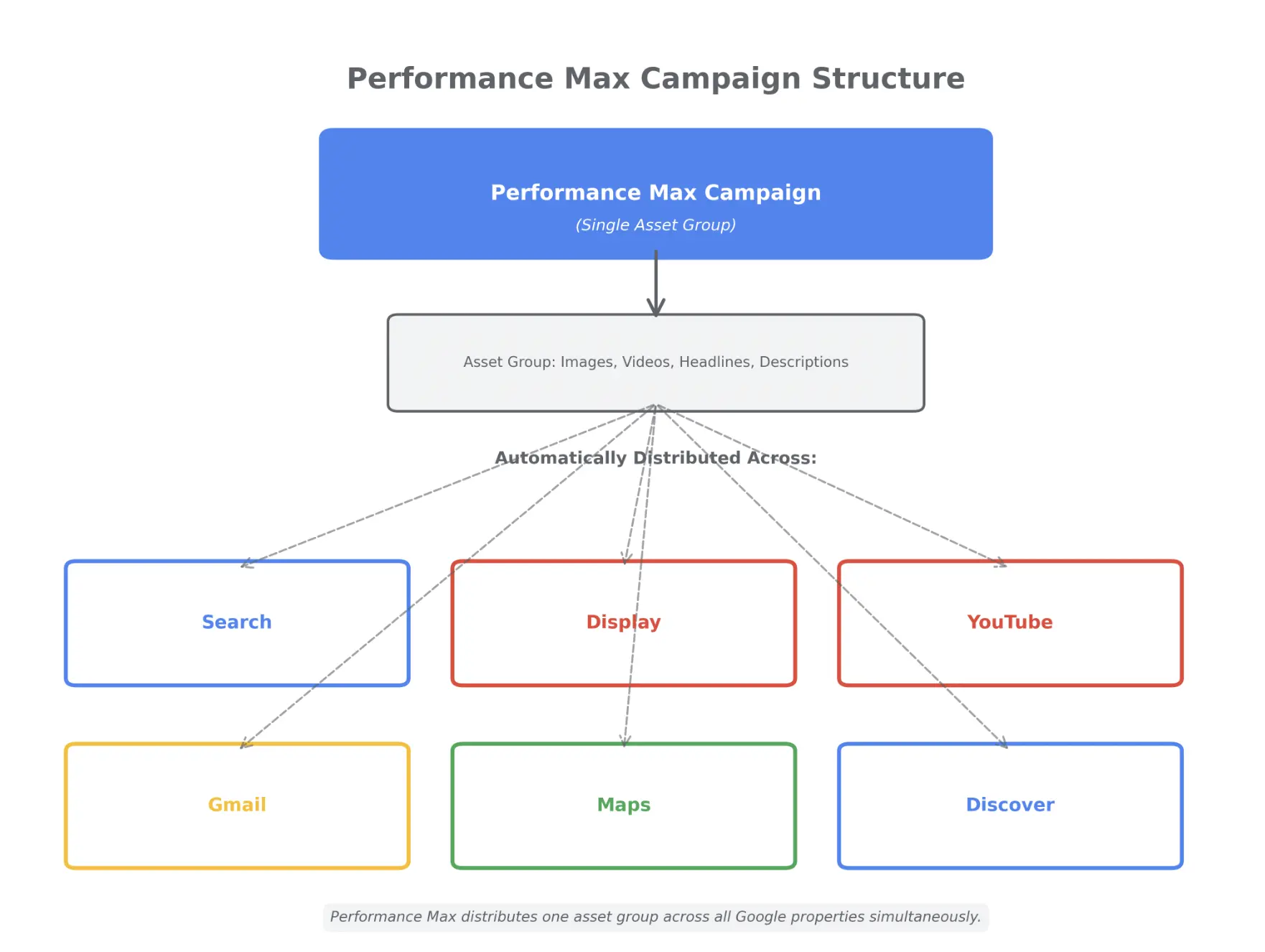
Modern campaigns often utilize “Smart Bidding,” where AI adjusts bids in real-time to maximize conversions or reach a target Return on Ad Spend (ROAS). This is exemplified by Performance Max (PMax) campaigns, which automate the delivery of ads across all of Google’s channels—Search, Display, YouTube, and Maps—using a single pool of assets and goals.
The Post-Click Experience: The Deciding Factor in ROI
While the “pre-click” phase is about visibility and traffic, the “post-click” phase is where the financial return is realized. Data suggests that sending paid traffic to a generic corporate homepage is one of the most common causes of campaign failure. Homepages are designed for exploration and contain multiple navigation links that act as “exit ramps,” distracting the user from the primary conversion goal.
Dedicated landing pages are the solution to this inefficiency. A high-converting landing page must maintain “Message Match,” meaning the headline of the landing page should mirror the promise made in the ad. If a user clicks an ad for a “Free 14-Day Trial,” but arrives at a page that discusses “Enterprise Consulting Services,” the cognitive dissonance leads to an immediate bounce.

Furthermore, technical performance is non-negotiable. Research indicates that a one-second delay in mobile page load time can reduce conversion rates by as much as 20%. In a competitive auction where clicks can cost upwards of $50 in sectors like law or finance, a slow-loading page represents a direct and significant financial loss.
Measurement and Attribution in a Privacy-First World
The transition to Google Analytics 4 (GA4) and the phasing out of third-party cookies have fundamentally changed how paid search performance is measured. Advertisers must now rely on first-party data and “Enhanced Conversions” to track the user journey accurately.
The most critical metric in 2025 remains the Conversion Rate. Because CPCs are rising due to increased competition, the most effective way to lower the Cost Per Acquisition (CPA) is to improve the efficiency of the landing page. For example, doubling a conversion rate from 2% to 4% effectively cuts the CPA in half without requiring any changes to the ad budget or keyword strategy. This “leverage” is why industry experts emphasize conversion rate optimization (CRO) as a core component of SEM.
Broader Economic Impact and Future Outlook
The continued dominance of paid search reflects a broader shift in corporate spending from traditional “interruption” marketing to “intent-based” marketing. As artificial intelligence becomes more integrated into search engines—through features like Google’s Search Generative Experience (SGE)—the nature of the “click” may change. Users may receive more information directly on the SERP, potentially leading to lower click volumes but higher intent for those who do click through.
For small and medium-sized enterprises (SMEs), the rising costs of paid search present a challenge. To compete with larger corporations, SMEs must focus on “long-tail” keywords—longer, more specific phrases that have lower competition and higher conversion potential. Additionally, the integration of local search (Google Maps) remains a vital, lower-cost entry point for businesses with physical locations.
In conclusion, paid search advertising in 2025 is an ecosystem of extreme precision. It is no longer enough to simply “buy keywords.” Success is found at the intersection of data-driven auction bidding, AI-optimized creative, and a seamless, high-speed post-click experience. As the market continues to expand toward the $355 billion mark, the brands that thrive will be those that view paid search not as a standalone tactic, but as a holistic journey from the first search query to the final conversion.