rifanmuazin
Strolling down a typical suburban street often reveals a fascinating, albeit unpolished, display of local marketing. One might encounter a sign, perhaps hand-drawn, with varying font sizes and less-than-perfect formatting, like the window cleaning advertisement recently observed in Houston. Despite its rudimentary aesthetic, a particular phrase on such a sign – “Window cleaning in progress” – can encapsulate a profound marketing truth often overlooked by sophisticated campaigns. This seemingly simple statement from a company like K&C Window Cleaning doesn’t resort to flashy slogans or aggressive claims. Instead, it employs a subtle, yet remarkably effective, psychological strategy.
This approach bypasses overt persuasion, instead leveraging deeply ingrained human tendencies. Rather than directly selling a service, the sign subtly prompts passersby to consider, “If others in my neighborhood are utilizing this service, perhaps it’s time for me to consider cleaning my windows too.” The power lies in the organic nature of this thought process; nothing feels forced or overtly commercial. This nuanced form of influence is rooted in the principle of social proof and the human desire for autonomy, two cornerstones of behavioral psychology that profoundly impact consumer behavior. Understanding these dynamics offers a critical advantage for businesses seeking to connect with their audience on a more fundamental level.
The Foundational Power of Social Proof

Social proof, a term popularized by psychologist Robert Cialdini in his seminal 1984 book Influence: The Psychology of Persuasion, describes the psychological and social phenomenon where people assume the actions of others in an attempt to reflect correct behavior for a given situation. Essentially, when individuals are uncertain, they look to the actions and behaviors of those around them for guidance. This tendency is deeply embedded in human evolutionary history, where conformity to group norms often ensured survival. In modern society, this manifests in various ways, from following fashion trends to choosing popular products and services.
Cialdini’s extensive research illuminated six key principles of persuasion, with social proof standing out as particularly potent. It suggests that individuals are more likely to comply with a request or adopt a behavior if they believe many others, especially similar others, are already doing so. This principle is not merely about popularity; it’s about validation. When we see others engaging in an activity, it reduces our perceived risk and increases our confidence in making a similar choice.
Cialdini’s Hotel Study: A Landmark Experiment
A classic illustration of social proof’s effectiveness comes from a 2008 study led by Robert Cialdini, conducted over 80 days in a mid-priced hotel in the American Southwest. The researchers aimed to encourage hotel guests to reuse their towels, a common environmental initiative. Across 190 rooms, involving over 1,058 guests, various messages were tested.

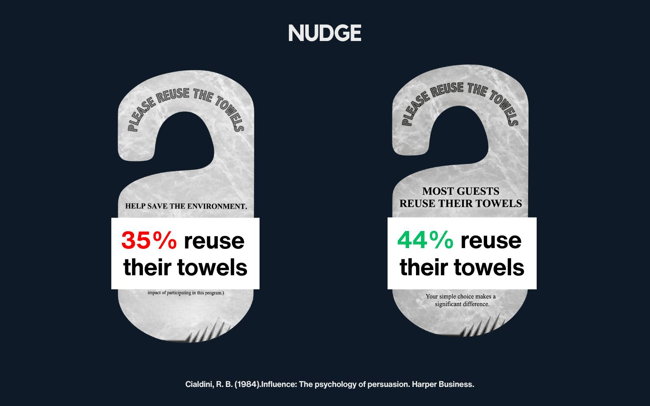
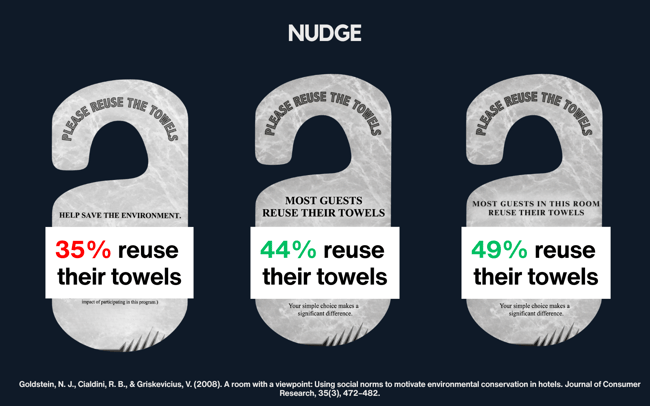
Initially, a standard environmental appeal was used: “Help save the environment.” While guests stated this message would be most persuasive, actual reuse rates hovered around 35%. The researchers then introduced a message leveraging social proof: “Most guests reuse their towels.” The results were compelling; towel reuse jumped significantly to 44%.
The study then introduced an even more localized form of social proof, refining the message to: “Most guests in this room reuse their towels.” This highly specific and relatable social cue proved even more powerful, pushing towel reuse rates to nearly 50%, a substantial increase from the initial environmental plea. This incremental improvement underscores a crucial nuance: the effectiveness of social proof is often amplified when the “others” are perceived as similar or relevant to the individual. A guest is more likely to be influenced by the behavior of someone who previously occupied their exact room than by a general appeal to environmentalism or even the broad behavior of all hotel guests.
This study provided robust empirical evidence for the intuitive notion that humans are deeply influenced by the actions of their peers. For businesses, the takeaway is clear: demonstrating that others are already enjoying a service or product can be far more persuasive than direct appeals to logic, quality, or even environmental consciousness. If a neighbor is seen having their windows cleaned, the psychological groundwork is laid for others in the community to consider the same service, not out of explicit marketing pressure, but from an implicit suggestion of accepted behavior.
The Crucial Role of Perceived Autonomy

While social proof is powerful, its efficacy can be enhanced or diminished by another fundamental psychological principle: the human desire for autonomy. Consumers, while influenced by others, strongly dislike feeling coerced or manipulated. This aversion to being told what to do is a core aspect of psychological reactance theory, which posits that when people perceive their freedom to choose is being threatened, they react by rebelling against the perceived threat, often doing the opposite of what is being pushed.
Marketing messages that are overly aggressive, boastful, or make absolute claims like “we’re the most popular” or “we’re number one” can inadvertently trigger this reactance. While such claims might work in some contexts, they often fall short because they imply a directive rather than an invitation.
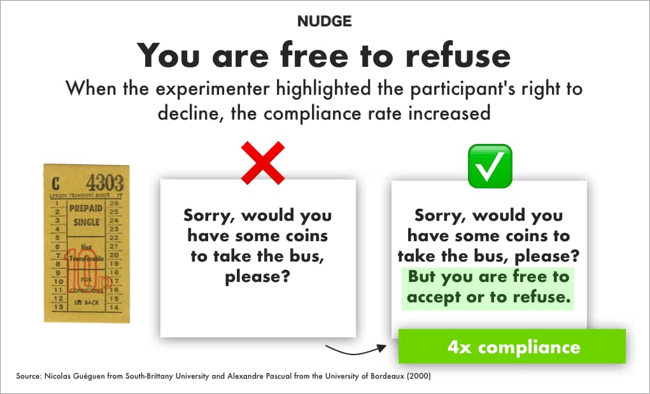
Research by Nicolas Guéguen in 2000 highlighted this phenomenon with the “but you are free to refuse” (BYAFR) technique. In one study, French commuters were asked for coins to buy a bus ticket. When a direct request was made, compliance was modest. However, when the request was followed by “but you are free to refuse,” the rate of compliance significantly increased. A meta-analysis in 2013 further validated the BYAFR technique, finding its effectiveness across 42 different domains, both online and offline.
This technique works by explicitly acknowledging the individual’s freedom, thereby reducing the perception of external pressure. When people feel that their choice is genuinely their own, they are more likely to comply with a request or consider an action. This is precisely why the K&C Window Cleaning sign, with its understated “Window cleaning in progress,” is so effective. It presents a factual observation of ongoing activity, allowing the viewer to independently draw the conclusion that the service is desirable, rather than dictating that belief. The decision to consider window cleaning feels organic and self-generated, backed by the implicit social proof of others’ engagement.
Applications in Modern Marketing and Business
The principles of subtle social proof and perceived autonomy are not confined to academic studies or local street signs; they are pervasive in successful marketing strategies across various industries.
E-commerce and Online Reviews: Perhaps the most visible application is in e-commerce. Websites prominently display customer reviews, star ratings, and even real-time notifications like “500 people bought this in the last 24 hours” or “X number of people are viewing this item right now.” These aren’t overt sales pitches; they are factual demonstrations of popularity and trust, allowing potential buyers to infer the product’s value. The sheer volume of positive reviews acts as compelling social proof, while the option to read both positive and negative feedback implicitly grants the consumer autonomy in their decision-making process.
Social Media Influence: Influencer marketing thrives on social proof. When an influencer, perceived as a peer or an aspirational figure, uses a product, their followers are more likely to consider it. The authenticity of the endorsement – often presented as a personal choice rather than a hard sell – is crucial to its effectiveness, tapping into both social proof and perceived autonomy.
Service Industries and Testimonials: Professional service providers, from consultants to healthcare practitioners, utilize testimonials not just as endorsements but as social proof. Hearing or reading about positive experiences from similar clients provides reassurance and validates the service’s quality without directly “selling.” The best testimonials highlight specific benefits and outcomes, allowing prospective clients to connect the dots themselves.
The Cafe Loyalty Card Example: Sam Tatam’s book, Evolutionary Ideas, provides another excellent example: a Sydney cafe that displays customers’ loyalty cards on a wall. Instead of a sign proclaiming “We’re popular,” the wall itself is a dynamic, visual testament to a thriving customer base. Each card represents a repeat customer, a tangible piece of social proof that implicitly communicates trust, satisfaction, and community. This method respects the customer’s autonomy, allowing them to independently observe the cafe’s popularity and draw their own conclusions about its appeal.
Ethical Considerations and Best Practices
While powerful, the application of social proof and autonomy principles must be handled ethically. Misleading claims or fabricated social proof can quickly erode trust and damage a brand’s reputation. The effectiveness of these tactics relies on their authenticity.
- Transparency: Businesses should be transparent about how social proof is generated. Genuine customer reviews, real usage data, and authentic endorsements are key.
- Relevance: Social proof is most effective when it comes from individuals or groups relevant to the target audience. For instance, testimonials from local community members might resonate more for a local business than general national statistics.
- Balance: While highlighting popularity, it’s important not to overwhelm or manipulate. The goal is to inform and guide, not to strong-arm.
- Empowerment: Always strive to empower the customer by making them feel that the decision is ultimately theirs. Providing options, acknowledging their freedom, and presenting information in a non-coercive manner fosters goodwill and long-term loyalty.
Broader Impact and Implications
The insights gleaned from studies on social proof and autonomy have profound implications beyond individual marketing campaigns. They highlight the intricate ways in which human psychology shapes economic decisions and social interactions. In an increasingly complex and information-saturated world, people naturally seek shortcuts for decision-making. Observing the choices of others provides a reliable heuristic, especially when faced with uncertainty.
For businesses, embracing these principles means shifting from a “tell-and-sell” paradigm to a “show-and-allow” approach. It involves a deeper understanding of human nature, recognizing that sustainable influence comes from subtle cues and respected autonomy, rather than aggressive persuasion. Businesses that master this delicate balance can cultivate stronger customer relationships, foster genuine trust, and ultimately achieve more organic and enduring growth. The humble “Window cleaning in progress” sign, therefore, stands not just as a piece of local marketing, but as a testament to the enduring power of understanding human psychology in the marketplace. By demonstrating value and popular acceptance without dictating choice, companies can make their offerings resonate more deeply, making decisions feel natural and truly their own for the customer.