rifanmuazin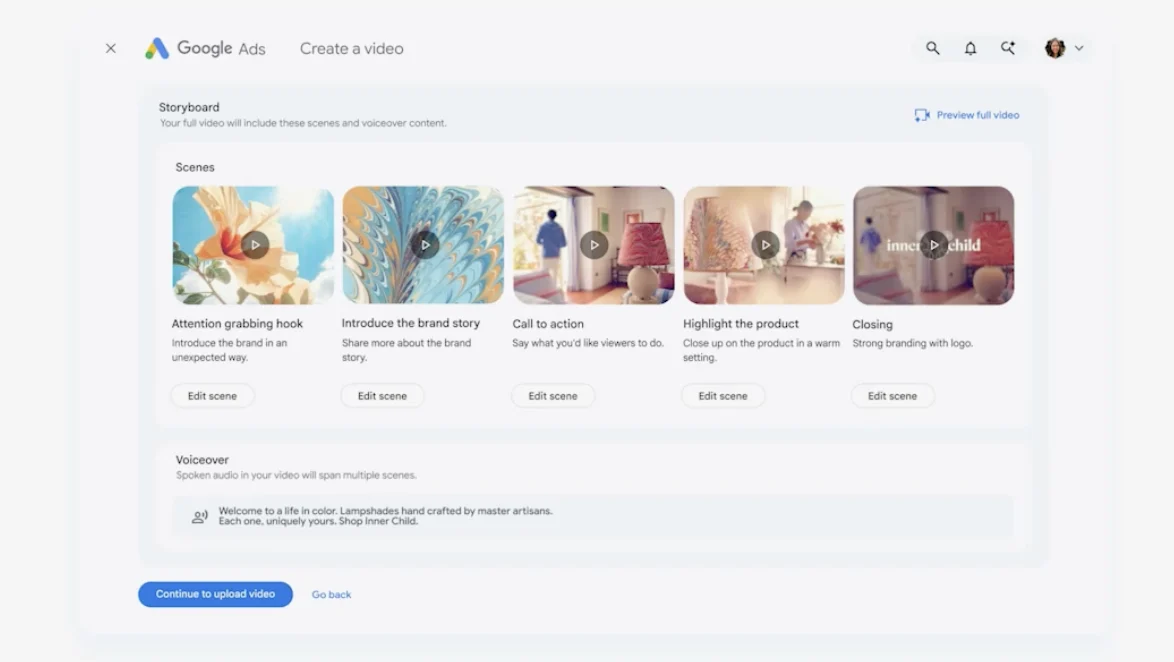
The annual Google Marketing Live (GML) event, this year themed around a vibrant festival atmosphere punctuated by playful nods to electronic music pioneers Daft Punk, has officially laid out Google’s ambitious vision for the future of digital marketing. Building on the momentum generated by Google I/O, GML 2026 showcased a suite of product innovations and strategic shifts, all coalescing around the central tenet: “Google search is AI search.” The event underscored a profound transformation in how marketers will operate, emphasizing the evolving role of search across the entire purchase journey, the pervasive integration of AI into performance campaigns, and the nascent but significant move towards agentic commerce.
For professionals immersed in performance marketing, the key themes emerging from GML 2026 were largely anticipated, yet their detailed articulation and the accompanying product announcements signal a decisive acceleration in Google’s AI-centric strategy. The core pillars identified included: the continuous elevation of AI’s role in performance campaigns, the enablement of agentic commerce, empowering marketers to transition from conversational engagement to tangible action, and leveraging YouTube’s comprehensive reach for both upper and lower-funnel objectives, all while refining media measurement solutions.
The overarching narrative from GML 2026 is the seamless fusion of artificial intelligence with the core functionalities of Google Ads and its broader marketing ecosystem. This transition, Google asserts, is not merely about introducing new tools but about fundamentally reshaping how marketers engage with their platforms, enabling them to become more strategic, connect business priorities more effectively with Google Ads, and prepare for a future characterized by potentially infinite creative possibilities.
Becoming More Strategic with AI: Empowering the Modern Marketer
The landscape of knowledge work, particularly within marketing, has undergone a significant evolution. The reliance on solely platform-native tools has diminished, with many marketers now integrating AI assistants like Claude or ChatGPT into their daily workflows. These tools are used for briefing AI in natural language, refining messaging, concept testing for creative, and strategizing audience engagement. Google’s announcements at GML 2026 reflect a keen awareness of this paradigm shift, presenting products designed to meet marketers where they are, rather than demanding a steep learning curve for new interfaces.
Ask Advisor: A Holistic Conversational Interface
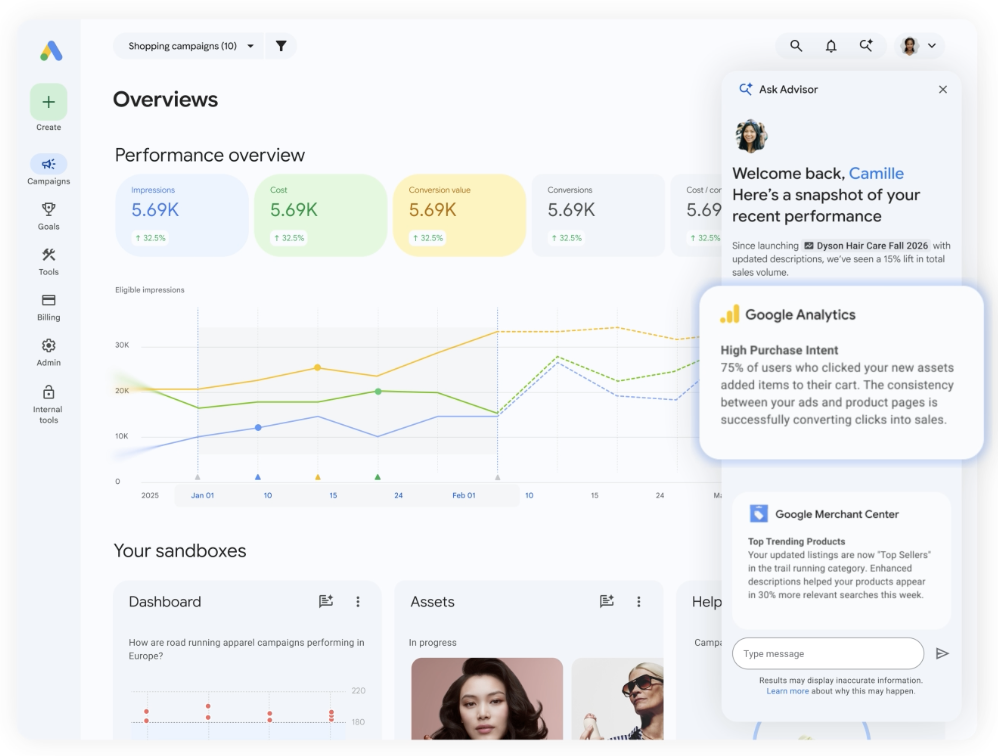
A standout innovation is Ask Advisor, an agentic conversational interface designed to span Google Ads, Google Analytics, Google Marketing Platform, and Merchant Center. By embedding specialized AI agents across these critical components of Google’s advertising and measurement ecosystem, Google aims to provide advertisers with a unified, conversational entry point for analyzing marketing strategies and identifying opportunities from a holistic perspective. This initiative represents nearly three years of development in conversational functionality within ads management. Previously, such capabilities were siloed within individual platform sections. If Ask Advisor performs as described, it promises to be an invaluable tool for diagnosing issues, surfacing insights, and uncovering new opportunities. Historically, interconnectivity within the Google ecosystem operated primarily on the back-end. Ask Advisor aims to democratize access to these insights, offering a novel interface that allows advertisers to engage with multiple facets of their marketing operations simultaneously, aligning with the prevalent trend of chat-based interactions.
AI Brief: Directing AI with Natural Language
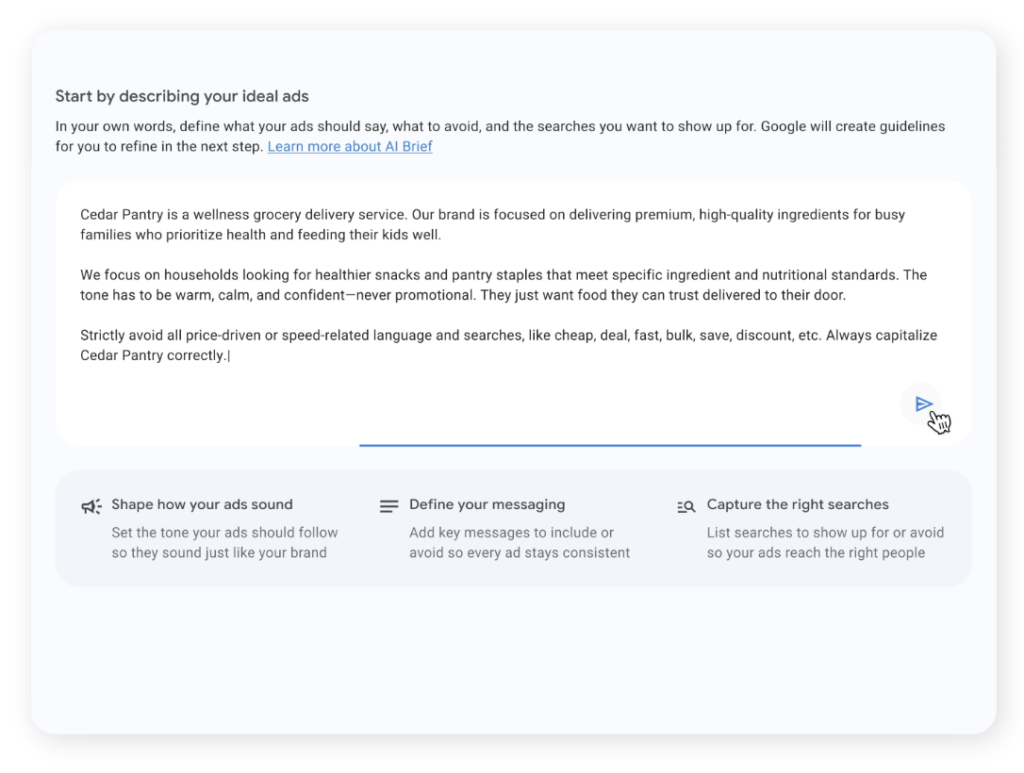
Chief Business Officer Philipp Schindler declared that “Google is firmly in our Gemini Agentic Era,” a sentiment that is now materializing within Google Ads through AI Brief. This new feature allows advertisers to guide AI Max and, eventually, Performance Max campaigns using natural language descriptions rather than solely relying on traditional settings and toggles. Advertisers can now articulate their brand’s essence – including messaging directives, prohibitions, audience priorities, and desired tone – directly into the system. Google then leverages this “brand brief” for Gemini to generate ad copy. This functionality represents a significant leap forward, moving beyond Google’s prior narrative of AI solely accelerating performance and creating efficiencies. For the first time, AI Brief establishes a direct causal relationship between a marketer’s ability to articulate customer needs and brand propositions and the subsequent campaign performance. This effectively elevates “brief writing” into a critical new skillset for paid search practitioners.
The implications of AI Brief are far-reaching. If implemented as a campaign-level setting, it opens the door for A/B testing not just variations in ad copy, but fundamentally different overarching brand propositions. This capability could provide invaluable strategic insights, answering the crucial business question: “Which proposition is resonating best within the market?” Furthermore, while currently focused on creative generation, the underlying technology of AI Brief holds potential for future expansion into bidding and targeting. A future iteration could allow briefs to include insights like “my most profitable customers have XYZ traits,” enabling Google AI to refine targeting without the need for complex customer match lists or value-based bidding implementations. This represents a forward-looking development that warrants close observation.
AI Max for Shopping Campaigns: Expanding Reach
AI Max for Shopping is a single-click toggle that extends AI Max capabilities to existing Shopping campaigns. Traditionally, Shopping campaigns match ads to queries based on product feed attributes like titles and descriptions. AI Max removes this constraint, enabling campaigns to respond to natural language and conversational queries that might not directly match any feed attribute. Google positions this as a method to capture long-tail demand that standard Shopping campaigns are structurally unable to reach.
This announcement presents two key considerations. Firstly, the question of whether to apply AI Max to existing Shopping campaigns is almost a foregone conclusion, given the shift towards conversational search. For most advertisers running standard Shopping campaigns, implementing AI Max to capture previously missed long-tail demand should be a priority.
Secondly, the integration of AI Max into Shopping campaigns raises questions about the future role of Performance Max (PMax). Both products are designed to capture demand beyond standard Shopping campaigns, including conversational queries. Google has yet to provide a definitive framework for distinguishing when to use each. Until such guidance is available, advertisers are advised to test AI Max on Shopping campaigns with clear baselines and monitor its performance, while treating the PMax integration as an open area for exploration and testing.
Communicating Business Goals with Enhanced Data Solutions
In an increasingly privacy-conscious digital environment where third-party tracking is facing greater restrictions, high-quality data inputs are paramount for any effective performance media program. First-party data has emerged as the primary mechanism for advertisers to communicate their business objectives to Google.
The seamless movement of consumers across channels and experiences has always presented tracking challenges. At Google I/O, the introduction of Universal Cart, a persistent shopping cart spanning Search, YouTube, Gmail, and Gemini, was announced. Beyond simplifying the consumer shopping journey, Universal Cart is poised to significantly improve the quality of data signals captured, ensuring more of the purchase journey occurs within environments where these signals are cleanly recorded.
The announcements at GML 2026 addressing data are driven by a common problem: signals fed into Google’s automated systems are often incomplete, misaligned with business goals, or prone to technical leakage. The solutions presented are Google’s direct response to these challenges, offering tangible improvements rather than mere repackaging.
Google Tag Gateway: Fortifying Conversion Tracking
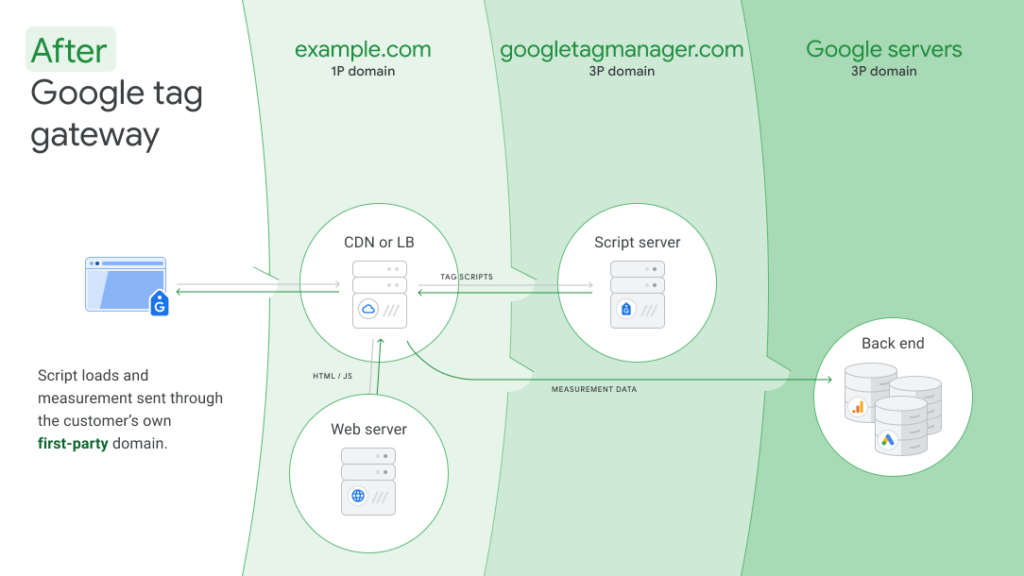
Google Tag Gateway (GTG) aims to enhance conversion tracking by routing tag signals through an advertiser’s own domain server, rather than directly through Google’s infrastructure. This approach is analogous to the Conversions API offered by other ad tech platforms, designed to mitigate data loss challenges through a distinct methodology. The practical benefits include improved data accuracy, higher match rates, and first-party data that is more resilient to browser-level tracking restrictions. A significant advantage highlighted by Google is that GTG requires no changes to existing tag code, enabling infrastructure upgrades without modifying site code.
While GTG is not entirely new, its presentation at GML 2026 as newly accessible for agencies, with one-click implementation, is noteworthy. This addresses a historical barrier to adoption: technical friction on the client side. Google has actively promoted GTG, even inviting agencies like Brainlabs to co-present training sessions. The critical question now is whether Google has sufficiently lowered the adoption barrier to drive widespread implementation. If so, the data quality disparity between early adopters and laggards is expected to widen considerably. Furthermore, GTG has demonstrated an 11% increase in signals for Confidential Matching, a program introduced at GML 2025, offering a direct performance advantage for clients who rely on customer match strategies.
Product Value Adjustments: Granular Control Over Conversion Values
Product Value Adjustments (PVAs) empower advertisers to apply multipliers to the conversion values of specific products within their catalog. This allows e-commerce advertisers to bid more aggressively on chosen SKUs within Shopping and Performance Max campaigns without altering campaign structures. While sophisticated advertisers may already employ methods to influence conversion value data sent to Google, the primary value of PVAs lies in their ease of application. Instead of complex offline or server-side modifications, PVAs enable direct adjustments within Merchant Center or Google Ads, promising a streamlined process.
Compared to Profit Optimization bidding, introduced at the previous year’s GML, PVAs are not only simpler to implement but also more versatile. Beyond optimizing for high-margin products, PVAs unlock a broad range of applications, such as:
- Promotional Adjustments: Temporarily increasing the value of products on sale to drive volume.
- Channel Prioritization: Adjusting values to favor sales from specific channels (e.g., direct website vs. marketplace).
- Customer Lifetime Value: Reflecting longer-term customer value for certain product purchases.
- Inventory Management: Deprioritizing or prioritizing the sale of specific products based on stock levels.
Welcome to the World of Infinite Creative: Gemini Omni Flash and Asset Studio
The creative advancements announced at GML 2026 are underpinned by Gemini Omni Flash, Google’s most advanced multimodal model, slated for release in Google Ads this summer. Designed to accept “any input” and produce “any output” – from text to video, image to copy, or brief to campaign – Gemini Omni Flash is the engine powering the concept of “infinite creative.” Asset Studio serves as the user interface for this capability, while Gemini Omni Flash provides the underlying generative power.
Asset Studio: A Unified Creative Workspace
Asset Studio is positioned as Google’s centralized creative hub within Google Ads, facilitating the generation, testing, and management of creative assets using Google’s advanced AI models. The key update for 2026 is the integration of multimodal capabilities, allowing advertisers to generate both images and video content through natural language descriptions. Users can also incorporate existing brand materials and marketing briefs to ensure on-brand output. A one-click A/B testing workflow is integrated directly into the creation process.
While Asset Studio has been available previously, its initial launch in 2025 reportedly fell short of advertiser expectations. The 2026 iteration’s success hinges on improved consistency in asset quality and the introduction of video generation capabilities, which would be a significant advancement. On-brand image generation has been available in various forms, but video generation at campaign scale represents a distinct challenge.
The one-click testing flow within Asset Studio is particularly noteworthy. Creative testing has long been an area where many advertisers fall short, either neglecting it entirely or conducting tests too informally to yield reliable results. If Asset Studio simplifies structured creative experimentation, it could fundamentally alter how creative strategy is approached. A critical outstanding question remains: whether Google’s definition of “brand safe” aligns with clients’ interpretation of “brand right.” High-volume, guideline-compliant creative does not always equate to creative that authentically reflects a brand’s voice and achieves optimal performance. The gap between these two aspects still necessitates expert creative direction.
Supporting Announcements: Expanding the Ecosystem
Beyond the headline innovations, GML 2026 featured a range of supporting announcements designed to further enhance the Google marketing ecosystem:
- Business Agents for Leads: A new ad type within AI Mode, designed for automotive, education, and real estate verticals, that encourages users to ask questions about a company or ad, connected to a lead form. Eligibility requires leveraging AI Max or Performance Max.
- Data Manager API: Google’s centralized hub for integrating first-party data sources (CRM lists, offline conversions, website events) into Google Ads, GA4, and GMP. The 2026 update includes direct connectors to platforms like Mailchimp, ActiveCampaign, and Klaviyo, and streamlines programmatic data flow setup. While announced at GML 2025, adoption has been slow. The addition of connectors to popular marketing platforms is a significant improvement, addressing a persistent barrier for mid-market advertisers.
- Affiliate Partnerships Boost: Enables merchants to discover and amplify organic YouTube Shopping affiliate videos within Demand Gen campaigns. This feature allows existing influencer content to be leveraged as paid placements, though it is currently in a limited US pilot.
- Commerce Media Suite: A unified suite connecting retail data, Google AI, and Google’s ad inventory. Key features include SKU-level measurement in DV360, cross-retailer and cross-brand reporting in SA360, and in-store reporting integrated with SA360. The SKU-level measurement in DV360 is particularly valuable for retail clients running programmatic campaigns, addressing a long-standing gap in attribution from upper-funnel display.
- View Through Conversion Optimization: An opt-in feature for Demand Gen campaigns on YouTube that allows bidding based on view-through conversion signals (conversions occurring after ad impression without a click). While view-through attribution has existed, direct optimization by the bidding algorithm represents a new approach, recommended for testing in scenarios where YouTube is already a significant part of the media mix.
- Demand Gen Uplift Experiments: An A/B experiment framework designed to measure the performance uplift of integrating Demand Gen into existing campaign mixes (PMax, Video, Display, App). This offers a direct answer to the question of Demand Gen’s placement and effectiveness relative to PMax, providing advertisers with the means to prove its value.
- Campaign Type Attribution: A new measurement approach that isolates conversions from Demand Gen campaigns, enabling accurate performance comparisons against paid social channels. This addresses a critical blocker for Demand Gen budget growth, allowing for clearer performance reporting that can be benchmarked against paid social metrics.
- Merchant Center for Agencies: A formalized launch of an MCC equivalent for Google Merchant Center, offering agencies a single login to manage multiple merchant clients at scale.
- Missed Opportunity Reporting: A reporting feature that visualizes lost conversion volume and value due to budget or bid constraints, intended to support requests for increased investment. Early reports suggest it provides helpful overviews but is not a transformative tool.
- Qualified Future Conversions (QFC): This feature leverages AI to predict the future engagement potential of campaigns, using user actions as early signals of intent without requiring custom tagging. QFC will eventually integrate with Meridian, Google’s open-source MMM, and is being incorporated into GA360.
What Comes Next: The Agentic Future of Marketing
Over the past five years, Google has prioritized AI-driven automation, sometimes at the expense of user visibility. While AI-powered targeting, bidding, creative, and budgeting have proven powerful, many marketers have struggled to strategically steer these systems. The traditional Google Ads UI, in some instances, has hindered the full embrace of AI’s potential.
The way marketers work has fundamentally shifted. The days of heavy reliance on spreadsheets for keyword, bid, and ad uploads are giving way to conversational interactions with Large Language Models and the creation of agents to automate workflows. The entry point for marketing engagement has changed, and Google’s embrace of these new working methodologies across its advertising solutions is a welcome development.
Google is equipping advertisers with agentic, AI-powered solutions for campaign management, a move that is broadly welcomed. Equally significant is the provision of enhanced data and improved conversion tracking capabilities. The immediate future lies in experimenting with these new features to identify the optimal solutions for specific business challenges, marking a new era of strategic marketing driven by intelligent automation and deeper insights.