admin
admin
In an era increasingly defined by artificial intelligence, Yoast SEO for Shopify has introduced a groundbreaking llms.txt feature designed to give e-commerce merchants unprecedented control over how AI tools interpret and present their product catalogs to potential customers. This development addresses a critical and growing concern among online businesses: the potential for Large Language Models (LLMs) like ChatGPT and Google Gemini to generate inaccurate, incomplete, or outdated descriptions of their products, leading to lost sales, damaged brand reputation, or even redirecting shoppers to competitors.
The digital landscape has undergone a profound transformation with the widespread adoption of generative AI. While these powerful tools offer immense potential for enhancing user experience and streamlining information discovery, their indiscriminate data scraping practices pose significant challenges for content creators and online retailers. Unlike traditional search engines that meticulously index entire websites, AI models often "grab what they can find, quickly, and fill in the gaps." For e-commerce stores boasting extensive product catalogs, this method can result in AI providing incomplete answers, outdated information, or, worst-case scenario, inadvertently directing potential customers to rival businesses based on flawed data. Yoast SEO’s llms.txt feature, now available to Shopify users, acts as a crucial bridge, guiding AI tools to the most pertinent and accurate information, thereby safeguarding brand integrity and optimizing customer journeys.
The Rise of AI in E-commerce and the Challenge for Merchants
The global e-commerce market, which Statista projects to reach approximately $8.1 trillion by 2027, relies heavily on accurate and compelling product information. As consumers increasingly turn to AI-powered assistants and conversational interfaces for product discovery and purchasing decisions, the manner in which these AI models access and process e-commerce data becomes paramount. A 2023 report by Salesforce indicated that 67% of consumers are open to using AI for shopping assistance, underscoring the urgency for businesses to adapt their digital strategies.
Traditionally, search engine optimization (SEO) has focused on robots.txt files, which instruct web crawlers on which parts of a website to crawl or not crawl. However, the paradigm shift brought about by LLMs necessitates a more nuanced approach. While robots.txt is effective for controlling access, it doesn’t dictate interpretation or prioritization of content for AI-driven summaries and recommendations. This distinction is vital for e-commerce, where product specifics, pricing, availability, and brand messaging are subject to frequent updates. Without a guiding mechanism, AI models might pull outdated product specifications from an old blog post or generate descriptions that misrepresent a brand’s unique selling propositions, directly impacting conversion rates and customer satisfaction.
Moreover, the challenge extends beyond mere accuracy. Inaccurate AI summaries can erode consumer trust. A survey by PwC highlighted that 85% of consumers prioritize trust when interacting with brands. If AI tools, acting as intermediaries, consistently provide incorrect information about a merchant’s products, this trust can be severely compromised, leading to a detrimental long-term impact on brand loyalty and sales. The llms.txt feature emerges as a timely solution to mitigate these risks, allowing merchants to proactively curate the narrative AI presents about their business.
Introducing llms.txt: A New Standard for AI Content Governance
The llms.txt feature functions as a bespoke directive for AI tools, analogous to how sitemap.xml provides a map for search engines. It generates a dedicated file that explicitly informs AI models about the most critical sections of a Shopify store. This includes, but is not limited to, top-selling products, key collections, essential policy pages (such as shipping, returns, and privacy), and crucial informational pages. Instead of allowing AI to indiscriminately wander through a website, llms.txt hands it a meticulously organized store guide, ensuring that the AI focuses its data retrieval efforts on the most relevant and current information.
The implementation of llms.txt is designed for simplicity and efficiency, offering two distinct modes for merchants:
-
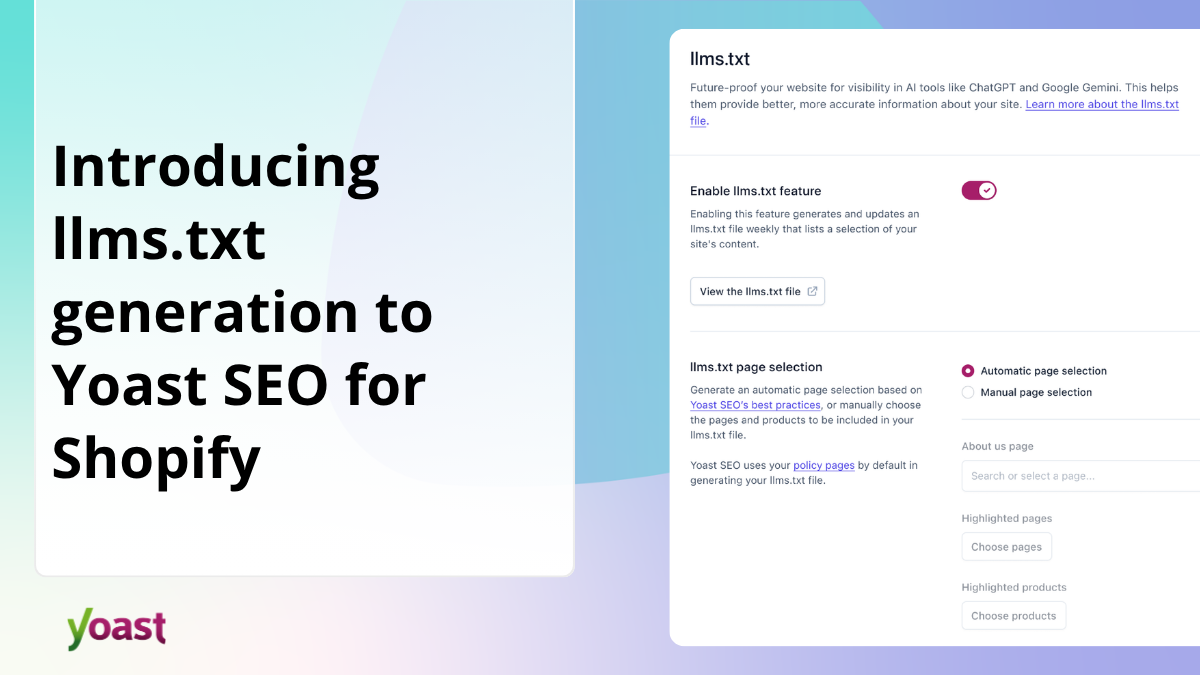
Automatic Management by Yoast: In this mode, merchants can activate the feature with a single toggle. Yoast SEO then takes over, automatically building and updating the
llms.txtfile on a weekly basis, leveraging the store’s existing Shopify data. This automated process intelligently highlights:- Products that have been recently updated: Ensuring AI always accesses the latest specifications, pricing, and availability.
- Products with recent sales: Signaling popular items that are likely of higher interest to potential customers.
- Top-performing products: Based on traffic or conversion data, these products are given priority for AI interpretation.
- New products: Ensuring fresh inventory is immediately visible and accurately described by AI.
- Key collection pages: Guiding AI to category overviews that help contextualize product offerings.
- Policy pages: Providing AI with accurate information on shipping, returns, and other crucial customer service aspects.
This "set it and forget it" approach is particularly beneficial for small to medium-sized businesses with dynamic inventories, allowing them to benefit from AI optimization without dedicating significant internal resources to manual data curation.
-
Manual Selection for Granular Control: For merchants who prefer absolute control over their AI-facing content,
llms.txtoffers a manual selection option. This allows store owners to hand-pick specific products and pages they wish to feature prominently to AI tools. A dedicated section is also provided for merchants to include their "About Us" page, ensuring AI accurately conveys the brand’s story, values, and mission. This level of customization is invaluable for brands with specific marketing campaigns, flagship products, or a unique brand narrative they want to ensure AI faithfully represents.
Regardless of the chosen method, the llms.txt file undergoes weekly updates, and crucially, it automatically removes references to deleted products, preventing AI from generating information about unavailable items. This consistent maintenance is critical for maintaining data integrity and customer satisfaction in fast-paced e-commerce environments.
Technical Simplicity, Strategic Impact
A significant barrier to adopting new technical solutions for many small businesses is the perceived complexity. Yoast SEO has explicitly addressed this by integrating llms.txt directly into its Shopify settings, requiring no technical knowledge or coding expertise. Any member of a merchant’s team can activate the feature in seconds, democratizing access to advanced AI content governance. Furthermore, Yoast has implemented safeguards: if a merchant already has a redirect set up for /llms.txt, the system respects this existing configuration and notifies the user, preventing any unintended disruptions. This thoughtful design underscores Yoast’s commitment to user-friendliness and seamless integration.
The strategic impact of this feature extends beyond mere technical convenience. It positions merchants to proactively shape their digital identity in the burgeoning AI economy. By explicitly guiding AI, businesses can:
- Improve Product Discoverability: Ensure AI-powered search and recommendation systems present accurate and relevant information, increasing the likelihood of purchase.
- Enhance Brand Messaging: Control the narrative AI conveys about their products and brand, reinforcing unique selling propositions and brand values.
- Reduce Misinformation: Minimize the risk of AI generating incorrect product details, pricing, or availability, which can lead to customer frustration and returns.
- Future-Proof SEO Strategy: Adapt to the evolving landscape where AI-generated summaries and conversational interfaces are becoming primary modes of information consumption.
- Boost Conversion Rates: More accurate and compelling AI descriptions can lead to higher quality leads and improved sales performance.
Merchant Control in the Age of AI
Yoast’s philosophy behind llms.txt is rooted in empowering merchants. The feature is opt-in, reflecting a strong belief that every business owner should have the ultimate say in how their content is accessed, interpreted, and utilized by AI systems. This principle aligns with a broader industry call for greater transparency and control in the age of AI, particularly concerning data usage and intellectual property.
"We believe that merchants, who have invested countless hours and resources into building their product catalogs and brand identities, deserve to dictate how their digital assets are consumed by emerging AI technologies," stated a hypothetical Yoast spokesperson. "The llms.txt feature is a direct response to the urgent need for tools that protect the integrity of e-commerce businesses in an AI-first world. It’s about giving power back to the creators and ensuring their hard work is represented accurately and effectively."
This emphasis on merchant autonomy is particularly relevant given ongoing debates about AI scraping practices and the attribution of content. By providing a clear directive, llms.txt can serve as a declaration of intent, signaling to AI developers how a business wishes its data to be treated.
The Broader Landscape: Data Scraping, IP, and the Future of Search
The introduction of llms.txt by Yoast SEO for Shopify marks a significant milestone in the evolving relationship between e-commerce, SEO, and artificial intelligence. It reflects a growing awareness within the tech community of the need for new protocols to govern AI’s interaction with online content. This feature could potentially lay the groundwork for industry-wide standards, similar to how robots.txt became a universal directive for web crawlers.
The discussion surrounding AI’s use of public web data for training models has raised complex legal and ethical questions regarding intellectual property rights, fair use, and compensation for content creators. While llms.txt is a voluntary compliance mechanism, its widespread adoption could encourage AI developers to prioritize ethical data sourcing and respect publisher directives, fostering a more symbiotic relationship between AI and content producers. As governments worldwide grapple with regulating AI, solutions like llms.txt demonstrate a proactive industry effort to establish guidelines for responsible AI behavior.
From a competitive standpoint, this move by Yoast positions it at the forefront of AI-driven SEO innovation. As other e-commerce platforms and SEO tools observe the effectiveness and adoption of llms.txt, it is plausible that similar features will emerge, leading to a new standard for AI content governance across the digital retail sector. This would ultimately benefit all online merchants, providing them with greater control and protection in an increasingly AI-dominated internet.
Expert Perspectives and Industry Reactions
Industry analysts have lauded the proactive approach taken by Yoast. Dr. Anya Sharma, a leading e-commerce technology expert, commented, "The llms.txt feature is not just a technical update; it’s a strategic imperative for any e-commerce business navigating the complexities of AI. It empowers merchants to safeguard their brand narrative and ensure their carefully curated product information is accurately represented, a critical factor for success in the AI-driven discovery economy."
Shopify merchants, who are often at the sharp end of dealing with online misinformation, have also expressed optimism. Sarah Chen, owner of a boutique clothing store on Shopify, shared, "We’ve seen instances where AI-generated product descriptions were wildly off, even suggesting products we don’t carry. This new Yoast feature gives us peace of mind that our unique designs and brand story will be accurately communicated, no matter how customers discover us."
Looking Ahead: The Evolving Role of SEO in an AI-Driven World
The introduction of llms.txt underscores a fundamental shift in the practice of SEO. While traditional SEO focused on optimizing for search engine algorithms, the rise of AI necessitates a focus on optimizing for AI models themselves. This means not only making content discoverable but also making it intelligible and prioritizable for LLMs.
The future of e-commerce SEO will likely involve a multi-faceted approach that integrates traditional ranking factors with new AI-specific directives. Merchants will need to consider how their content is structured not just for human readers and search engine crawlers, but also for AI models that synthesize information for conversational interfaces and generative responses. Tools like llms.txt will become indispensable for managing this complexity, ensuring that brands maintain control over their digital narrative in a landscape where AI acts as a primary gatekeeper of information.
The continued evolution of AI will undoubtedly bring new challenges and opportunities for online businesses. However, by providing merchants with robust tools to guide AI’s understanding of their content, Yoast SEO for Shopify is helping to ensure that the human effort behind every product catalog and brand story remains respected and accurately conveyed, allowing businesses to thrive in the dynamic digital future. Merchants are encouraged to activate the llms.txt toggle in Yoast SEO for Shopify during their next login to their store, taking a decisive step towards mastering their brand’s presence in the AI-powered online world.