

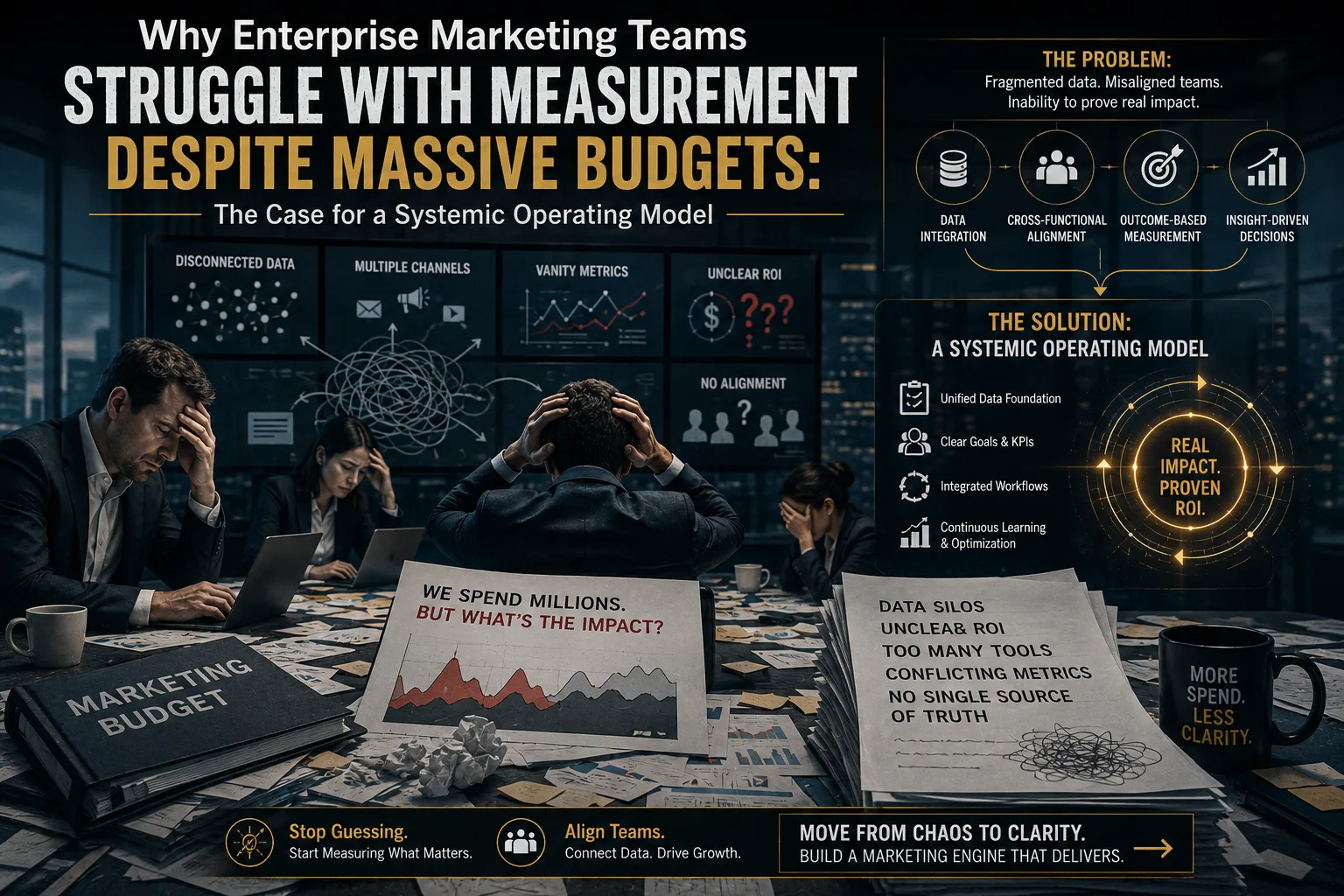
The persistent inability of large-scale enterprise marketing and communications teams to prove the return on investment (ROI) of their activities is not a failure of data collection but a fundamental flaw in organizational systems, according to recent industry analysis. Despite possessing significantly larger budgets, more extensive headcounts, and sophisticated technology stacks, enterprise-level communications functions are scoring no higher in “visibility readiness” than solo practitioners. Data derived from the PESO Model® Diagnostic indicates that the gap between doing the work and proving its value is widening, leading to a breakdown in trust between marketing departments and the C-suite. This disconnect suggests that the “measurement problem” frequently cited by marketing leaders is merely a symptom of a deeper integration crisis.
The Measurement Trap and the Integration Deficit
In the current corporate landscape, marketing and communications professionals are under increasing pressure to justify their spend. The standard response to this pressure is to seek better dashboards, more granular tracking tools, or complex attribution models. However, the core issue often lies in the fact that the activities being measured are fundamentally disconnected. For a measurement framework to be effective, the underlying marketing channels—Paid, Earned, Shared, and Owned (PESO)—must function as a cohesive ecosystem.
When these channels operate in silos, the resulting data is fragmented. A content engine may produce high volumes of “Owned” media, but if that content does not fuel “Earned” media relations or get amplified through “Shared” social channels, the impact is localized and often invisible to the broader business. Analysts note that you cannot apply a unified gauge to a system that does not operate as a system. The “measurement problem” is, therefore, often an “integration problem” in disguise.
Data Analysis: The Parity Between Enterprise and Solo Operations
A recent batch of data from the PESO Model® Diagnostic has revealed a startling trend regarding organizational readiness. The diagnostic, which scores operations across the four media pillars and their integration, expected to find that large organizations with robust resources would outperform smaller entities. The results, however, showed a statistical dead heat.
Enterprise organizations, defined by their significant budgets and large teams, achieved an average visibility readiness score of 45. In contrast, solo practitioners—individuals managing the entire marketing function alone—scored an average of 44. This single-point difference suggests that massive financial investment and high headcount do not inherently lead to better strategic alignment or more provable outcomes.
Further analysis of the highest-resourced organizations (those with 50 or more staff members) revealed a specific paradox: while these teams often had the highest scores for “connected channels,” they had some of the lowest scores for “systemic operation.” These organizations had invested heavily in the infrastructure of integration but had failed to install a strategic “operating system” to run it. Consequently, the majority of these large teams remain in “pilot mode,” characterized by experimentation rather than consistent, scalable operation.
The Evolution of the PESO Model as an Operating System
The PESO Model®, originally authored by Gini Dietrich in 2014, was designed to move communications away from a pure media relations focus toward a more integrated approach. In the decade since its inception, the model has evolved from a tactical framework into what industry leaders now describe as a “business operating system.”
- Owned Media: This serves as the foundation, consisting of the content and assets a brand fully controls.
- Earned Media: This provides the third-party credibility and “trust” factor that cannot be bought.
- Shared Media: This involves the community-driven amplification of messages across social platforms.
- Paid Media: This ensures targeted distribution and reach for the most effective assets.
The failure of many enterprise teams lies in treating these as four separate buckets of activity. A systemic approach requires that each channel feeds the next. For example, an “Owned” white paper should be the source material for an “Earned” guest column, which is then promoted via “Paid” social ads and discussed in “Shared” community forums. Without this circularity, the “Invisibility Gap” persists, regardless of the total budget spent.
The C-Suite Perspective: Shifting the Budget Conversation
The primary reason marketing budgets are often scrutinized or cut is the way they are framed during resource allocation meetings. When marketing is presented as a series of disconnected expenses—such as “more content” or “SEO investment”—it is viewed by the Chief Financial Officer (CFO) as a cost center. This framing invites the demand for immediate, direct proof of the last dollar spent before another is granted.
To secure long-term funding and strategic buy-in, the conversation must shift from “marketing tactics” to “operating systems.” This systemic framing addresses the specific concerns of various C-suite stakeholders:
- The Chief Marketing Officer (CMO): Seeks defensible outcomes that connect marketing activity to business growth, reputation, and revenue.
- The Chief Financial Officer (CFO): Focuses on efficiency and the cost of inaction. A systemic approach promises higher leverage, where one piece of content works across four channels, maximizing the return on a single investment.
- The Chief Information Officer (CIO): Is concerned with data, AI policies, and technical infrastructure. An integrated system addresses how a company’s narrative is surfaced in AI-driven search environments.
- The Chief Communications Officer (CCO): Prioritizes reputation management. A coherent, integrated narrative provides a “reputation moat” that protects the company during crises.
- The Chief Executive Officer (CEO): Looks for strategic alignment. An operating system sounds—and acts—more strategic than a collection of disparate campaigns.
The Role of AI and the New Discoverability Challenge
A significant factor contributing to the urgency of adopting a systemic operating model is the rise of Artificial Intelligence (AI) in search and information retrieval. Search Generative Experience (SGE) and AI models like ChatGPT and Perplexity are changing how audiences find information.
AI models prioritize “high-authority” and “consistent” information. If a brand’s “Owned” media is not corroborated by “Earned” media mentions or “Shared” community validation, it is less likely to be surfaced by AI as a credible answer to a user’s query. This makes integration a technical necessity rather than just a creative preference. The “Invisibility Gap” in the age of AI is no longer just about missing a page-one ranking on Google; it is about being entirely excluded from the generative answers that are becoming the primary interface for B2B and B2C decision-making.
Chronology of a Failed Measurement Strategy
The path to a “measurement problem” typically follows a predictable timeline in large organizations:
- The Resource Surge: An organization hires specialists for SEO, social media, and PR, often housing them in different departments.
- The Tactical Boom: Each specialist executes high-quality work within their own silo. Content is produced, tweets are sent, and press releases are distributed.
- The Fragmentation Phase: Because there is no central “operating system,” the social team doesn’t know what the PR team is pitching, and the SEO team is optimizing for keywords that don’t align with the brand’s strategic narrative.
- The Boardroom Inquiry: Leadership asks for a report on how these activities contributed to the bottom line.
- The Measurement Crisis: The marketing lead realizes they have plenty of “activity data” (likes, clicks, impressions) but no “outcome data” (revenue, lead quality, market sentiment).
- The Dashboard Search: The team looks for a new software tool to “fix the measurement,” failing to realize the data cannot be unified because the activities themselves were never unified.
Implications and Future Outlook
The findings from the PESO Model® Diagnostic serve as a warning for enterprise teams that believe they can “buy” their way to effectiveness. The data proves that readiness is a matter of architecture, not just investment. As Gartner research suggests that the typical B2B buying journey now involves six to ten stakeholders, the need for a single, integrated story has never been higher.
Moving forward, the successful communications functions will be those that stop acting as “activity centers” and start acting as “system conductors.” This requires a shift in mindset from “doing more marketing” to “installing the system the business has already paid for.” By focusing on the integration of Paid, Earned, Shared, and Owned media, organizations can close the visibility gap, satisfy the C-suite’s demand for accountability, and ensure their brand remains discoverable in an increasingly AI-driven world. The measurement will not be the goal, but rather the natural byproduct of a system that is finally running as intended.









