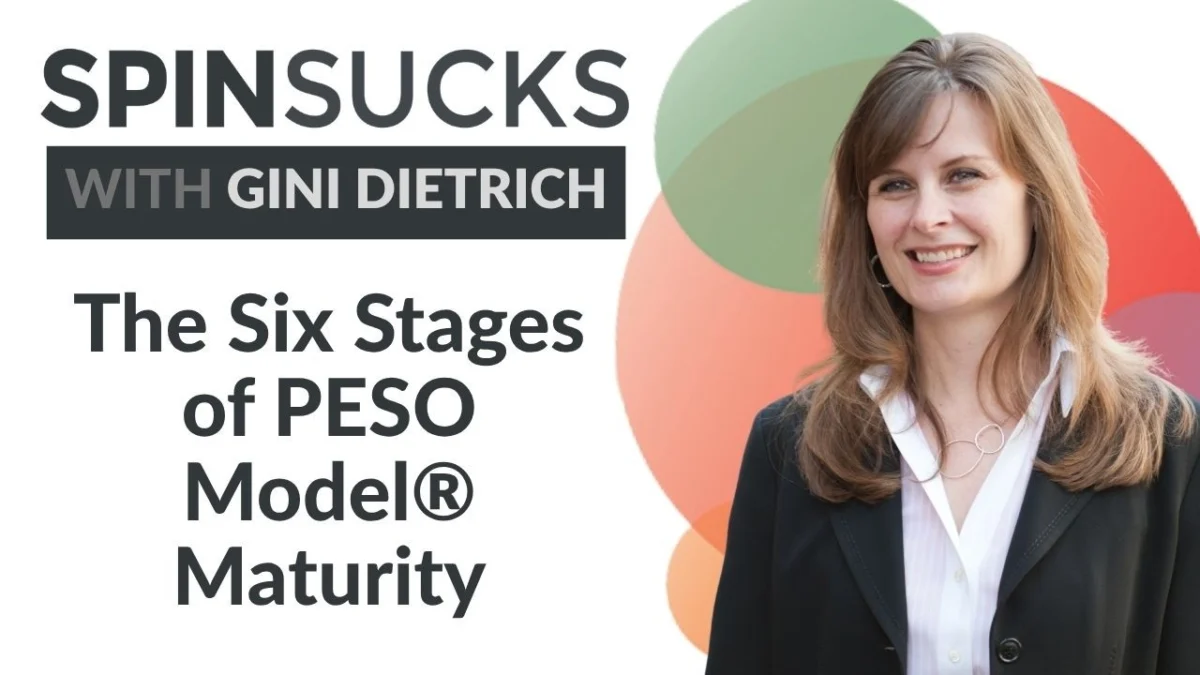
The marketing and communications industry is currently facing a significant disconnect between professional self-perception and operational reality, according to new data released by Spin Sucks. A comprehensive study utilizing the newly launched PESO Model Diagnostic has revealed that while nearly half of marketing teams describe their operations as "integrated," a staggering 91% remain relegated to the bottom half of the PESO Model maturity ladder. This "integration gap" suggests that while the industry has widely adopted the terminology of integrated marketing, the structural and systemic implementation of the Paid, Earned, Shared, and Owned (PESO) framework remains elusive for the vast majority of organizations.
The findings arrive as the PESO Model, originally introduced by Gini Dietrich in 2014, transitions from a conceptual graphic into what industry experts are calling a formal "operating system" for the digital age. This evolution necessitates a more rigorous evaluation of how teams actually function, moving beyond tactical execution toward a sophisticated, data-driven hierarchy of maturity.
The Six Stages of PESO Maturity
The maturity ladder is structured into six distinct stages, ranging from foundational tactical execution to industry-leading strategic dominance. According to the diagnostic data, exactly zero percent of participating organizations have reached the highest rung of the ladder, highlighting the difficulty of achieving true operational integration.
Stage 0: Foundation
At the Foundation level, channels operate in isolation. While an organization may utilize Paid, Earned, Shared, and Owned media, these functions are managed by disparate teams with independent calendars and non-aligned Key Performance Indicators (KPIs).
A notable example of Foundation-level operations can be found in large-scale B2B enterprises like Oracle. Despite possessing significant market share in the AI infrastructure and healthcare data sectors, the organization’s media types often function as silos. Paid media may focus on lead generation, Earned media reacts to executive movements, and Owned media serves as technical documentation. While each channel is active and well-funded, they lack a unifying narrative or cross-channel amplification strategy. For teams at this stage, the primary challenge is moving away from channel-specific planning toward a unified story.
Stage 1: Pilot
The Pilot stage is characterized by the successful execution of isolated integrated campaigns. At this level, a team may come together for a high-profile initiative, but the collaborative discipline does not persist once the campaign concludes.
McDonald’s serves as a primary case study for the Pilot stage. The brand frequently executes world-class integrated moments, such as the Travis Scott Meal or the Grimace Shake campaign. During these periods, Paid, Earned, Shared, and Owned media work in perfect harmony to drive cultural relevance. However, once these specific "moments" end, the organization often reverts to separate regional marketing, franchise pushes, and value-menu promotions managed by different agencies and teams. At the Pilot stage, integration is treated as a "special event" rather than a standard operating procedure.
Stage 2: Scale
At the Scale level, integration becomes a recurring behavior. Organizations at this stage run multiple integrated campaigns per year and have established shared KPIs between marketing and communications departments.
Dove’s "Real Beauty" platform is a quintessential example of Scale-level maturity. For two decades, the brand has launched integrated campaigns—such as "Real Beauty Sketches" and "#ShowUs"—that coordinate across all four media types. However, the data indicates that even at this level, the function itself is not yet fully operationalized as a 365-day system. The periods between major launches often see a return to standard CPG (Consumer Packaged Goods) performance media and product pushes that lack the same cross-channel synergy.
Stage 3: Systemize
The transition to the Systemize stage represents a major structural shift. At this level, integration is no longer a behavior but a permanent function. Organizations typically appoint a dedicated "PESO Integrator" and utilize shared dashboards to track cross-channel performance in real-time.
Sephora’s retail operation demonstrates Systemize-level maturity through its Beauty Insider loyalty program. This data layer connects digital interactions (Owned), community signals (Shared), and creator partnerships (Earned) with targeted advertising (Paid). While the system is highly effective, it often operates on quarterly review cycles, which can prevent it from reacting instantly to rapid cultural shifts or emerging social media trends.
Stage 4: Real-Time
At the Real-Time stage, the operating system becomes agile. Decisions regarding budget reallocation and content pivots are made in days or hours based on integrated data.
Netflix exemplifies this stage through its response to breakout hits. When a series like Squid Game or Wednesday gains traction, the entire brand pivots. Paid media is reallocated within 72 hours, Earned media teams secure talent for immediate press, and the Owned media algorithm reorganizes the homepage to capitalize on the trend. This level of maturity requires the dashboard to be treated as a live instrument rather than a retrospective reporting tool.
Stage 5: Leadership
At the pinnacle of the ladder, the PESO operating system becomes the brand’s competitive moat. The way the company integrates its communications is considered a primary reason for its market success and is studied by competitors and academics alike.
Liquid Death, the canned water company, has achieved a billion-dollar valuation by making its marketing operation its primary product. The water itself is incidental to a PESO strategy where Owned media (brand-as-content) provokes Earned media, and Shared media (creator collaborations) drives the narrative. At this stage, the integration is so complete that it influences hiring, product development, and enterprise strategy.
Analyzing the Integration Gap: Data Insights
The diagnostic data revealed several critical discrepancies in how marketing professionals view their work. Of the participants surveyed, 68% claimed to run PESO as a formal system. However, 100% of those respondents actually scored within the bottom two rungs (Foundation or Pilot) when their tactical data was analyzed.
Furthermore, 47% of respondents described themselves as "integrated" across all four media types, yet their operational scores placed them firmly at the Pilot or Foundation levels. Only a marginal fraction—two individuals out of the entire data set—scored above the Scale level.
This gap is attributed to a "discipline problem" in the AI era. While tools for content creation and distribution have become more accessible, the structural discipline required to connect those tools across different media types has not kept pace. Many teams mistake "using all four channels" for "integrating all four channels."
Chronology of the PESO Evolution
The journey of the PESO Model reflects a decade of change in the communications landscape:
- 2014: The PESO Model is introduced in Gini Dietrich’s book Spin Sucks, providing a visual framework for the overlapping nature of digital media.
- 2018-2020: The rise of influencer marketing and the decline of organic social reach force brands to move beyond Earned media, leading to early adoption of integrated tactics.
- 2023: The "Operating System" concept is introduced, arguing that PESO is not just a marketing plan but a structural requirement for organizational efficiency.
- 2024: The launch of the PESO Model Diagnostic provides the first quantitative data set regarding industry maturity, revealing the 91% stagnation rate.
Industry Implications and Future Outlook
The implications of this data are profound for the future of the marketing and communications industry. As AI continues to saturate the "Owned" and "Shared" channels with high-volume content, the "Earned" and "Paid" channels must work in tighter coordination to ensure brand authority and visibility.
Industry analysts suggest that the failure to move up the maturity ladder is often a result of "rounding up" internal capabilities. Organizations that believe they are at the Scale or Systemize level are unlikely to invest in the structural changes—such as hiring a dedicated integrator or developing cross-channel attribution models—necessary to actually reach those stages.
For agencies, the data presents an opportunity to move beyond execution and into strategic consultancy. Clients who are "stuck" at the Foundation level require more than just a press release or a social media ad; they require a structural overhaul of how their internal teams communicate.
The move toward higher maturity levels is not merely an aspirational goal but a survival mechanism in a fragmented media environment. As demonstrated by brands like Netflix and Liquid Death, the ability to operate an integrated system provides a durable advantage that cannot be easily replicated by competitors. The path forward for the remaining 91% of the industry lies in a ruthless honest assessment of their current standing and a commitment to incremental, structural moves toward true integration.