
 rifanmuazin
In the modern digital economy, the primary differentiator between market leaders and struggling enterprises is no longer just the quality of the product, but the ease with which a customer can interact with the brand. While many organizations focus on "delighting" customers through grand gestures, research suggests that the most significant driver of loyalty is actually the reduction of friction. Customer Effort Score (CES) has emerged as a critical metric for businesses seeking to quantify this friction and streamline the user journey.
The concept of the Customer Effort Score was first introduced to the mainstream business community in 2010 through a seminal Harvard Business Review article titled "Stop Trying to Delight Your Customers." The study, conducted by the Corporate Executive Board (now part of Gartner), revealed a counterintuitive truth: exceeding customer expectations during service interactions has a negligible impact on loyalty. Conversely, increasing the effort required to resolve a problem or complete a transaction is a primary driver of disloyalty.
The Evolution of Customer Experience Metrics
To understand the significance of CES, one must look at the chronology of customer experience (CX) measurement. Historically, businesses relied on Customer Satisfaction (CSAT) scores to gauge performance. CSAT measures a customer’s emotional reaction to a specific interaction. Later, the Net Promoter Score (NPS) became the industry standard for measuring long-term brand advocacy by asking how likely a customer is to recommend a service to others.
However, both CSAT and NPS often fail to capture the operational reality of a user’s struggle. A customer might be "satisfied" with a friendly support agent (high CSAT) but still feel frustrated that it took three phone calls to fix a simple billing error (high effort). CES fills this analytical gap by focusing on the "ease of use" across the customer lifecycle.
The Mechanics of Measuring Customer Effort
Measuring CES involves a structured survey methodology. Unlike complex longitudinal studies, a CES survey is typically a single-question instrument deployed immediately after a key touchpoint. The standard question recommended by researchers is: "To what extent do you agree with the following statement: The company made it easy for me to handle my issue."

Respondents typically answer on a 7-point Likert scale, ranging from "Strongly Disagree" (1) to "Strongly Agree" (7). The score is calculated by finding the average of all responses. In some variations, businesses use a 5-point scale or an emoticon-based scale to increase response rates in mobile environments.
According to industry benchmarks, a score above 5.0 on a 7-point scale is generally considered "good," while scores above 6.0 indicate a "low-effort" experience that is highly conducive to customer retention. Conversely, scores below 3.0 serve as an immediate red flag for potential churn.
Critical Deployment Scenarios
The efficacy of CES is highly dependent on timing. Unlike NPS, which is often sent at fixed intervals (e.g., every six months), CES is transactional. It must be triggered by specific events in the customer journey to capture accurate, real-time perceptions of effort.
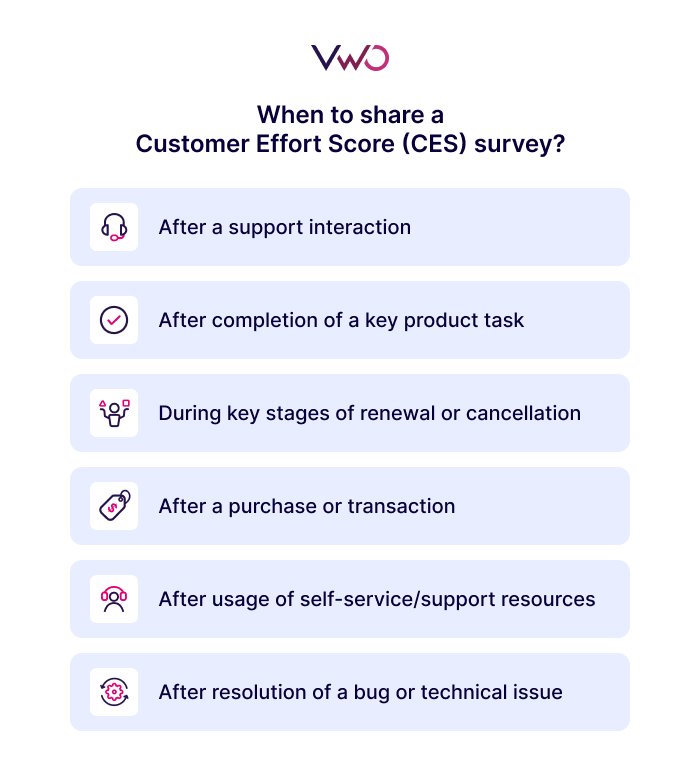
- Post-Support Interactions: This remains the most frequent use case. Whether a customer uses live chat, email, or a phone call, measuring the effort required to reach a resolution provides direct feedback on the efficiency of the support infrastructure.
- Product Milestones: For Software-as-a-Service (SaaS) companies, CES is often triggered after a user completes a critical task for the first time, such as setting up an integration or inviting a team member. This identifies "onboarding friction" that could prevent long-term adoption.
- Transactional Completion: In e-commerce, the period immediately following a purchase or a return is a vital window. High effort during the checkout or return process is a leading indicator of cart abandonment and lost lifetime value.
- Self-Service Assessment: As more companies move toward AI-driven chatbots and knowledge bases, CES helps determine if these self-service tools are actually helpful or if they are merely barriers that force customers to eventually seek human intervention.
Supporting Data and the Impact of Friction
The business case for prioritizing a low-effort experience is backed by significant quantitative data. Gartner’s research indicates that 96% of customers who experience high-effort interactions become disloyal, compared to only 9% of those who experience low-effort interactions. Furthermore, the cost to serve a customer in a low-effort environment is approximately 37% lower than in a high-effort environment, primarily because of reduced "channel switching" (e.g., a customer calling because they couldn’t find an answer on the website).
Friction manifests in various forms: repetitive data entry, navigating complex phone menus (IVR), being transferred between multiple departments, and the "silent killer" of loyalty—the need for a customer to contact a company multiple times for the same issue.
Jon MacDonald, a prominent voice in conversion rate optimization, notes that every element on a digital platform sends a signal of trust or confusion. When these signals create "cognitive load," the customer’s instinct is to seek a simpler alternative, regardless of the brand’s perceived prestige.

Strategic Implementation and Operational Efficiency
To improve a Customer Effort Score, organizations must move beyond data collection and into operational iteration. This process generally follows a four-step cycle:
First, businesses must map the customer journey to identify "friction points." This is often done using behavioral analytics, such as heatmaps and session recordings, which show where users click out of frustration or linger too long on a confusing form.
Second, companies should invest in "proactive service." By anticipating common hurdles—such as sending an automated tutorial when a user gets stuck on a specific page—brands can resolve issues before the customer even perceives them as "effort."
Third, the streamlining of support channels is essential. This includes "one-contact resolution" mandates, where agents are empowered with the authority and tools to solve problems without escalating them to supervisors.
Fourth, organizations must use qualitative feedback to supplement the quantitative CES. A low score tells you that an experience was hard; the open-ended follow-up comment ("Why was it difficult?") tells you how to fix it.
The Role of Technology and AI in Effort Reduction
Modern CX platforms, such as VWO Pulse, are increasingly integrating AI to automate the CES process. AI-generated survey questions can now be tailored to the specific context of a user’s behavior. For instance, if a user spends five minutes on a pricing page without making a selection, an AI-triggered survey can ask if finding the right plan was easy or difficult.
Furthermore, predictive analytics can now estimate a Customer Effort Score before a survey is even sent. By analyzing metadata—such as the number of clicks, the time spent on a page, and the number of times a user visited the "Help" section—algorithms can flag high-effort sessions for immediate intervention by customer success teams.
Broader Implications for Market Competitiveness
As the barrier to entry for new competitors continues to drop in almost every industry, the "effort economy" will dictate market share. Customers no longer compare a bank’s mobile app only to other banks; they compare it to the seamless experience of Uber, Netflix, or Amazon.
The transition from a "satisfaction-based" strategy to an "effort-based" strategy represents a fundamental shift in corporate philosophy. It moves the focus from the brand’s desire to be "liked" to the customer’s desire to be "efficient." In the long run, businesses that respect their customers’ time by minimizing effort will see higher retention rates, lower operational costs, and a more sustainable competitive advantage.
The Customer Effort Score is not merely a metric for the support department; it is a vital sign for the entire organization. From product design and engineering to marketing and sales, every department plays a role in reducing the friction that erodes customer loyalty. By systematically measuring and improving CES, companies can transform their customer experience from a point of frustration into a streamlined engine for growth.








