rifanmuazin
The marketing landscape is undergoing a profound transformation, driven by the rapid evolution of artificial intelligence. Over the past year, the conversation has pivoted from discrete AI tools to comprehensive AI systems, with a growing focus on autonomous AI agents capable of learning, executing tasks, and operating within defined parameters. While the vision of a fully AI-enhanced marketing organization is compelling, many Chief Marketing Officers (CMOs) find themselves constrained by established budgets, reporting structures, and existing team capacities. This reality necessitates a pragmatic approach: integrating AI agents into the current organizational framework rather than attempting a wholesale redesign.
This strategic integration allows organizations to experiment with AI, build internal confidence, and demonstrate tangible operational improvements before committing to significant structural changes. This approach is not merely a temporary workaround but a deliberate pathway to unlocking AI’s potential within the practical constraints of modern marketing departments.
The Inertia of Organizational Structure: Why Radical Redesigns Remain Elusive
Despite a growing recognition of AI’s transformative power, the prospect of a complete overhaul of marketing organizational charts remains a distant reality for most CMOs. The inertia of established operational frameworks presents significant hurdles. Budgets for the current fiscal year are typically finalized, leaving little room for major structural investments. Reporting lines are deeply entrenched, dictating communication flows and decision-making hierarchies. Furthermore, marketing teams are often operating at full capacity, making it challenging to allocate resources for extensive organizational redesigns.
This practical reality underscores the importance of a phased integration strategy. Instead of envisioning a future state from scratch, leaders are increasingly focused on identifying specific pain points within existing workflows where AI agents can deliver immediate value. A key question emerging for marketing leaders is: "Where inside our existing workflows could AI agents remove operational drag and enhance efficiency?" This question shifts the focus from abstract organizational theory to tangible, actionable improvements.
Building Blocks of AI Integration: Augmenting Core Marketing Functions
The most effective starting point for integrating AI agents lies within the core functions that already exhibit repeatable workflows. These include content creation, demand generation, social media management, and analytics. The objective is not to replace human roles but to augment the capabilities of existing teams, enabling them to achieve more with existing resources.
Content Creation: Amplifying Strategic Voices
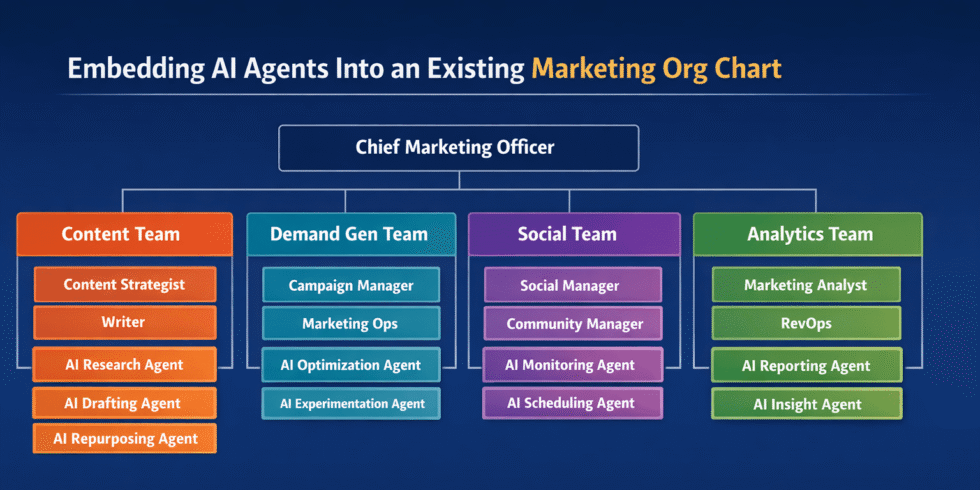
A content strategist’s role typically encompasses a broad spectrum of activities, from initial research and editorial planning to drafting, editing, and distribution. AI agents can be strategically deployed to streamline specific stages of this process. For instance, an AI research agent can efficiently gather competitive intelligence and identify relevant keywords, providing a solid foundation for campaign planning. Drafting agents can generate initial versions of blog posts, landing page copy, or email newsletters, significantly reducing the time spent on initial content generation. Furthermore, AI-powered repurposing agents can automatically transform long-form content into digestible social media snippets or concise email summaries, maximizing content reach and impact. In this model, the content strategist retains ownership of the overarching narrative, brand voice, and final output, while the AI handles much of the repetitive, time-consuming operational burden. This allows human strategists to dedicate more time to higher-level tasks such as creative ideation, strategic positioning, and nuanced editorial refinement.
Demand Generation: Optimizing Campaign Performance
Demand generation teams often invest substantial effort in monitoring campaign performance, identifying optimization opportunities, and conducting A/B testing. AI agents can significantly enhance these efforts. By continuously analyzing vast amounts of campaign data, these agents can proactively identify underperforming elements, suggest data-driven optimizations, and even recommend budget adjustments within pre-defined thresholds. This allows demand generation specialists to move beyond reactive adjustments to a more proactive, predictive approach to campaign management, maximizing return on investment and driving more qualified leads.
Analytics: Accelerating Insights and Reporting
The analytics function, while critical, can often be bogged down by the manual process of data aggregation and report generation. Executives may spend mere minutes reviewing reports that analysts spent hours compiling. AI agents can automate the creation of dynamic dashboards, summarize key performance insights, and automatically flag anomalies or significant deviations from expected trends. This empowers human analysts to focus on interpreting the data, drawing deeper strategic conclusions, and providing more actionable recommendations, rather than getting lost in the mechanics of report assembly.
In each of these scenarios, AI agents are designed to integrate seamlessly into existing structures, acting as powerful collaborators rather than replacements. This phased introduction allows human team members to focus on strategic oversight, quality assurance, and acting as critical gatekeepers before final content is published or decisions are finalized.
Designing Agents Around Workflows: A Modular Approach to Automation
A highly effective strategy for AI integration involves designing AI agents around specific stages of existing workflows. Consider a simplified content workflow, which might involve ideation, research, drafting, editing, and distribution. Each of these stages presents a clear opportunity for automation or intelligent assistance. Rather than attempting to deploy a monolithic AI system to manage the entire content team, organizations can deploy smaller, specialized agents that support individual steps.

This modular approach offers several distinct advantages. Firstly, it allows teams to introduce automation gradually, minimizing disruption and enabling a smoother learning curve. Secondly, it maintains clear lines of human oversight at each stage, ensuring that AI-driven outputs are aligned with strategic goals and brand standards. Thirdly, it fosters an environment of experimentation, allowing teams to test and refine AI applications without derailing established processes. Most importantly, this phased and integrated approach helps employees perceive AI as a valuable collaborator, enhancing their capabilities rather than threatening their roles.
At Heinz Marketing, for example, an internal library of AI agents has been developed to support specific marketing workflows. These agents are designed to assist with tasks ranging from initial research and content generation to campaign development and performance optimization, demonstrating a commitment to practical, workflow-centric AI implementation.
The Three Stages of AI Autonomy: A Gradual Path to Intelligent Operations
The integration of AI agents into marketing operations does not necessitate a single, uniform level of autonomy. Instead, AI adoption typically progresses through three distinct stages, allowing organizations to scale their AI integration responsibly:
-
Assistive Stage: In this initial phase, AI agents function as intelligent assistants. They generate recommendations, provide insights, or produce preliminary drafts that are then reviewed and refined by human operators. This stage is often the starting point for many organizations, as it introduces minimal risk while delivering immediate productivity gains by automating tedious tasks. For example, an AI might suggest headline variations for an article or identify potential customer segments for a campaign.
-
Collaborative Stage: Moving beyond simple assistance, AI agents in the collaborative stage perform larger portions of work. This might include generating full drafts of blog posts, compiling comprehensive performance reports, or proactively suggesting campaign optimizations based on real-time data. However, human approval remains a critical step before any actions are finalized or implemented. This stage represents a deeper integration where AI takes on more significant responsibilities, but human judgment and oversight are still paramount.
-
Controlled Autonomy Stage: This advanced stage involves AI agents executing certain tasks automatically within clearly defined operational guardrails. Examples include automated adjustments to paid media bids within a predetermined range, the generation and distribution of routine performance reports without human intervention, or the scheduling of social media content based on predefined criteria. This level of autonomy requires robust governance frameworks and thorough testing to ensure that AI systems operate reliably and align with organizational objectives.
The progression through these stages is a deliberate process. Moving too rapidly can introduce unforeseen risks and operational disruptions, while moving too slowly can limit the potential benefits and competitive advantages offered by AI. By adjusting the level of autonomy gradually, organizations can optimize their AI integration for maximum effectiveness and minimal disruption.

Governance and Accountability: Establishing Guardrails for AI Operations
As AI agents become increasingly embedded in daily operations, the question of governance and accountability becomes critically important. Establishing clear frameworks for who is responsible for AI outputs is essential to avoid confusion and maintain trust. Key questions that need to be addressed include:
- Who is accountable for the accuracy and appropriateness of AI-generated content?
- What are the protocols for reviewing and approving AI-driven campaign adjustments?
- How will data privacy and security be ensured when AI agents are handling sensitive information?
- What are the procedures for addressing errors or unintended consequences of AI actions?
Addressing these governance questions proactively helps organizations avoid potential pitfalls and build confidence in their AI initiatives. Effective governance does not necessarily equate to heavy bureaucracy; often, it involves clearly defining operational guardrails. For instance, an organization might mandate human review for all customer-facing content generated by AI, while allowing automated reporting or campaign monitoring to operate with greater independence. Establishing these boundaries is crucial for building internal trust and ensuring that AI systems operate responsibly and ethically.
Measuring the True Impact: Beyond Output Volume to Strategic Capacity
When introducing AI agents, success should not be measured solely by the volume of outputs generated. The true value of AI integration often lies in its impact on operational efficiency and the expansion of strategic capacity within the marketing team. CMOs should closely monitor metrics such as:
- Reduced campaign cycle time: How quickly can campaigns be conceived, launched, and optimized?
- Faster content production velocity: What is the turnaround time for creating and distributing various content formats?
- Improved experimentation velocity: How frequently can the team conduct meaningful A/B tests and gather insights?
- Increased time spent on strategic work: What proportion of team members’ time is now dedicated to higher-level strategy, planning, and innovation, as opposed to manual tasks?
These indicators often reveal the tangible impact of AI integration long before direct revenue attribution can be definitively measured. Demonstrating these improvements in operational efficiency and strategic capacity can be instrumental in securing buy-in from the CEO and the broader leadership team for continued AI investments.
The Evolution of the Marketing Organization: From Embedded Agents to AI-Enhanced Teams
The strategic embedding of AI agents into an existing organizational structure represents the initial phase of a broader transformation. As AI becomes more deeply integrated, certain workflows will become highly automated, while others will remain fundamentally human-driven, emphasizing creativity and nuanced judgment. New roles may emerge, focusing on AI orchestration, performance monitoring, and the development of robust governance frameworks. Over time, these cumulative changes will naturally reshape the structure and dynamics of the entire marketing organization.
For most CMOs, the most prudent and effective path forward involves starting with existing workflows, identifying areas where AI can alleviate the most significant friction points, and allowing the organization to evolve organically from there. This pragmatic approach recognizes that the future marketing organization will likely be a hybrid, seamlessly blending human creativity with AI-powered execution.
| Stage | What Happens | Example |
|---|---|---|
| Workflow Support | AI assists specific tasks within a process. | AI drafts initial blog post outlines. |
| Role Augmentation | AI supports and enhances the capabilities of entire roles. | AI assists demand generation specialists in campaign optimization. |
| Operational Integration | AI becomes a fundamental, embedded component of daily workflows. | Automated optimization of paid media bids. |
| Structural Evolution | The organizational chart and team structures adapt to leverage AI. | Emergence of AI orchestration roles, AI-enhanced team structures. |
The marketing organization of the future will almost certainly be a hybrid model, harmonizing human ingenuity with the efficiency and analytical power of AI. For organizations actively exploring how AI agents can be integrated into their current marketing structures, Heinz Marketing offers its experience and insights. The team is available to share learnings from their internal development and testing of these systems. For inquiries, contact [email protected].