rifanmuazin
The landscape of B2B marketing has undergone a significant transformation, particularly concerning the measurement and impact of thought leadership. Historically, the influence of B2B thought leadership was often perceived as almost magical. A well-executed research report or a series of insightful executive perspectives would lead to increased visibility, and, with a touch of mystery, pipeline growth would follow. The precise mechanics linking these efforts to tangible business outcomes were often opaque, shrouded in a veil of perceived effectiveness rather than demonstrable data.
However, the advent of modern analytics has begun to demystify this process. B2B marketing leaders now possess the tools to observe how thought leadership influences engagement and drives pipeline progression, though the full picture remains fragmented. The primary challenge lies in synthesizing disparate data points that are typically siloed across various reporting systems. Brand engagement metrics might reside in one platform, campaign performance data in another, and revenue figures are often locked within Customer Relationship Management (CRM) systems. The critical missing piece has been a clear, cohesive view of how these individual signals interrelate and contribute to overall business objectives. Unified analytics is emerging as the solution to bridge this gap, providing the necessary visibility to connect the dots.
Thought Leadership’s Integration within the "Best Answer Marketing" Framework
Within the strategic framework of Best Answer Marketing (BAM), a concept championed by leading B2B marketing organizations, thought leadership is fundamentally rooted in insightful, original content. This insight can manifest as original research, proprietary data analysis, or a clearly articulated point of view grounded in deep expertise and verifiable proof. The power of this insight is not confined to a single piece of content; it acts as a foundational element that informs a multitude of marketing activities.
This core insight fuels the creation of executive perspectives, drives influencer collaborations, underpins demand generation programs, supports sales enablement efforts, and continuously informs ongoing brand publishing initiatives. The consistent narrative, originating from this core insight, is then disseminated across a wide array of touchpoints. This includes search engine results, social media conversations, webinars, industry events, and direct outreach campaigns. When influence is strategically deployed across such a broad spectrum of interactions, capturing its full impact within a single, isolated dashboard becomes an insurmountable task.

The Measurement Gap Hindering Thought Leadership’s True Potential
The fragmentation of data across multichannel thought leadership programs presents a significant limitation in understanding their true influence. As Jane Bartel, Director of Search & Content Marketing at TopRank Marketing, articulates, "Measuring the influence of thought leadership on marketing outcomes means understanding how it advances buyers through the journey and impacts the KPIs that track their progression. Each format and channel produces data points framed around metrics that each tell part of the larger story. To prove the value of thought leadership and to surface insights for optimizations, two things are crucial: unified analytics and a measurement model that translates multiple signals into a cohesive view."
When engagement metrics, opportunity data, and revenue outcomes are tracked in isolation, quantifying the overarching influence of thought leadership becomes exceptionally difficult. Consequently, investment decisions can inadvertently skew towards activities that are easiest to measure, leading to an overemphasis on individual channel outputs while cross-channel influence receives less scrutiny. Bridging brand, demand, and sales data within a unified analytical framework is therefore essential to making this often-elusive influence visible and actionable.
Insights from High-Performing Teams on Achieving Visibility
Empirical data reinforces the critical need for integrated visibility. A comprehensive study, "The State of B2B Thought Leadership in 2026," revealed that approximately one-third of marketers identify limited visibility into funnel performance as a primary challenge. An equally significant portion, another third, reported an over-reliance on a small number of marketing channels, further hindering a holistic understanding of campaign effectiveness.
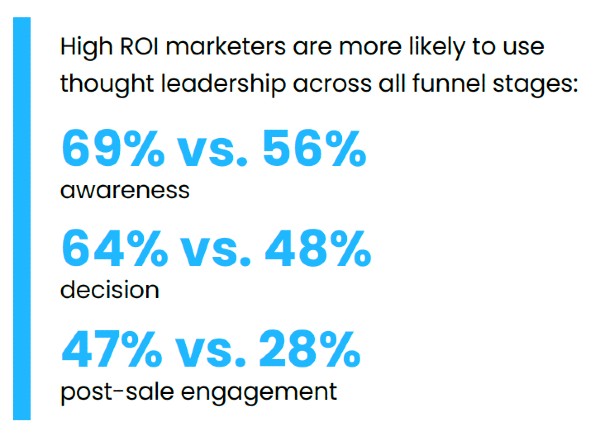
The study also highlighted a stark correlation between measurement capabilities and content performance. A substantial 41% of respondents indicated that difficulty in measuring content performance is the leading reason for their content underperforming. Conversely, higher-performing B2B organizations demonstrate a strategic advantage. These teams are more adept at distributing thought leadership across multiple stages of the buyer’s journey and exhibit a greater propensity to connect brand-building activities directly with revenue outcomes. The implication is clear: underperformance in B2B marketing is less often a result of insufficient effort and more frequently a consequence of a lack of integrated visibility across marketing initiatives.

Redefining Success: Moving Beyond Impressions to Measurable Influence
Multichannel thought leadership initiatives generate a diverse array of engagement signals. These can range from website visits and content downloads to webinar registrations, social media shares, and direct inquiries. Each of these interactions signifies activity, but when viewed collectively, they paint a picture of forward momentum in the buyer’s journey.
Consider a common scenario: a company releases original industry research. Initially, this report garners downloads. Subsequently, some individuals may attend a follow-up webinar, while others engage with executive commentary that contextualizes the research findings. Sales teams then leverage this research in their conversations with active accounts, further embedding the company’s expertise into the buyer’s consideration set. Over time, accounts and stakeholders who have been exposed to these multiple touchpoints are observed to enter the sales pipeline at higher rates and progress through the various stages with greater efficiency.
These observable behaviors can be directly mapped to key performance indicators such as opportunity creation, pipeline velocity, and ultimately, revenue contribution. By shifting the definition of success from isolated impressions to demonstrable buyer progression, organizations can gain a more accurate understanding of thought leadership’s true impact.
The Imperative of Unifying Data Across the Entire Buyer Journey
Unified analytics, when designed to encompass the entire customer journey, acts as the foundational infrastructure for comprehensive measurement. It seamlessly integrates data from awareness, engagement, conversion, and post-sale activities into a single analytical environment. This unified approach is crucial for revealing both the milestone achievements and the cumulative impact of marketing efforts.

Connecting Cross-Channel Activity for Deeper Insights
Effective measurement necessitates the integration of signals from a wide range of marketing channels and platforms. This includes:
- Brand Awareness & Engagement Platforms: Tools that track website traffic, social media interactions, content consumption, and public relations mentions.
- Demand Generation Systems: Marketing automation platforms that manage lead nurturing, email campaigns, and event registrations.
- Sales Enablement Tools: Platforms that provide sales teams with content and resources, often tracking their usage and effectiveness.
- Customer Relationship Management (CRM) Systems: The central repository for customer data, sales pipelines, and closed-won deals.
- Advertising & Media Monitoring Tools: Platforms that track paid media performance and brand sentiment across various channels.
When these disparate datasets are integrated, discernible patterns in buyer behavior and campaign effectiveness begin to emerge.
Attribution and Modeling at Scale: The Next Frontier
Understanding the complex, multichannel influence of thought leadership often requires sophisticated attribution models and analytical frameworks. This typically involves:
- Multi-Touch Attribution (MTA): Models that assign credit to various touchpoints a customer interacts with on their journey to conversion.
- Marketing Mix Modeling (MMM): Statistical analysis that measures the impact of various marketing channels and their contribution to overall sales and revenue.
- Data Integration and Transformation: The process of collecting, cleaning, and structuring data from multiple sources into a usable format for analysis.
Manual data aggregation can significantly hinder strategic analysis. Daniel Kravtsov, CEO of Improvado, highlights this challenge: "Measuring the impact of multi-channel thought leadership programs requires sophisticated analytics. At times, it takes a combination of Marketing Mix Modeling and Multi-Touch Attribution to understand how content influences the pipeline across channels. The problem is that marketing orgs spend 20–40% of their time manually aggregating data from Google Analytics, social platforms, CRMs, and media monitoring tools, rather than running these analyses. Without a unified analytics infrastructure, you can’t build reliable attribution models or MMM frameworks. Complex programs demand complex measurement."
Building Executive Confidence Through Evidence-Based Insights
Unified analytics fundamentally alters how marketing leadership engages in revenue discussions. It provides Chief Marketing Officers (CMOs) and other senior leaders with a shared, comprehensive view of engagement, opportunity, and revenue data across all relevant systems. Interactions with research, repeated exposure to thought leadership content, and account-level activity can now be evaluated alongside pipeline performance and closed revenue figures. This integration allows thought leadership to be considered within the same analytical framework as other strategic growth investments.
With this enhanced visibility, marketing leaders are empowered to:
- Demonstrate ROI: Clearly articulate the return on investment for thought leadership initiatives by linking them to tangible business outcomes.
- Identify High-Impact Narratives: Pinpoint which core messages and narratives resonate most effectively with target audiences and drive desired actions.
- Optimize Program Performance: Make data-driven adjustments to underperforming programs or content strategies, reallocating resources for maximum impact.
- Inform Strategic Investment Decisions: Justify continued or increased investment in thought leadership by presenting clear, evidence-based performance data.
Transforming Thought Leadership into a Sustainable Growth Engine
When measured comprehensively across the entire customer journey, thought leadership evolves from a brand-building exercise into a sustained driver of revenue growth. Unified analytics provides the essential structure to manage these relationships deliberately and effectively.
By measuring engagement, opportunity progression, and revenue contribution in concert, thought leadership becomes a manageable and predictable growth lever. High-impact narratives can be strategically reinforced, while underperforming efforts can be identified and adjusted. Crucially, investment decisions can be made with a higher degree of confidence, supported by clear, actionable evidence. Ultimately, with pervasive visibility across the buyer’s journey, thought leadership transforms into a consistent, measurable, and potent force for driving business growth.

To delve deeper into how leading B2B marketers are achieving this integration, exploring research such as "The State of B2B Thought Leadership in 2026" can provide invaluable insights into connecting brand, demand, and revenue, and building the measurement systems necessary to support sustained growth. This evolving understanding of thought leadership’s impact signifies a maturing discipline within B2B marketing, moving from perceived magic to demonstrable, data-driven success.