Dwi Wanna

Snap Inc., the parent company of the popular ephemeral messaging app Snapchat, released its third-quarter 2026 earnings report on Wednesday, revealing a complex financial landscape characterized by resilient revenue growth juxtaposed against stalled user expansion in its most lucrative markets. The report underscores the company’s ongoing efforts to diversify its revenue streams and innovate, even as it contends with intensifying competition and a burgeoning global regulatory push impacting youth engagement on social media platforms.
User Growth Plateaus in Key Regions
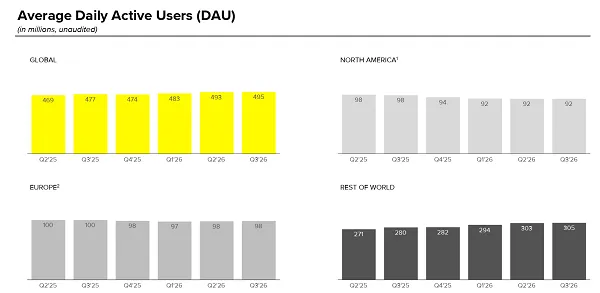
The Q3 2026 report indicated that Snapchat now boasts 495 million daily active users (DAU) globally, a modest increase of just 2 million from the 493 million reported in Q2. This incremental growth, while positive on a headline level, masks a significant underlying challenge: all user growth originated from the company’s "Rest of World" segment. Crucially, Snapchat experienced no growth whatsoever in daily active users within its North American and European markets. This stagnation in its most financially significant regions presents a potential impediment to long-term revenue acceleration, as these territories historically generate the vast majority of Snap’s advertising income.
For context, previous quarters have shown similar trends, with user growth often concentrated outside of North America and Europe. This pattern highlights a saturation point or increased competitive pressure within mature markets, compelling Snap to seek expansion in emerging economies where digital penetration is still growing but monetization opportunities are inherently different. The company’s inability to attract new users in regions with high advertising spend per user signals a need for renewed strategies to re-engage or broaden its appeal in these core territories.
Strong Revenue Performance Despite User Headwinds
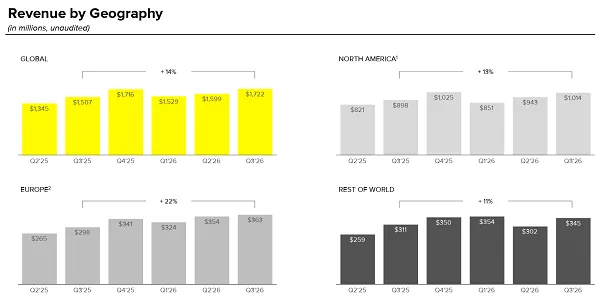
Despite the flatlining user growth in key regions, Snap Inc. reported a healthy 14% year-over-year increase in overall company revenue, reaching $1.72 billion for Q3 2026. This performance demonstrates the company’s ability to extract more value from its existing user base, particularly in high-yield markets.

A closer examination of the regional revenue breakdown reveals significant disparities and strategic implications. North America led the charge, with revenue up 13% year-over-year to $1.01 billion. Europe also saw impressive growth, climbing 22% to $363 million. The Rest of World segment contributed $345 million, an 11% increase. While the revenue figures for Europe and the Rest of World appear relatively close, this comparison is skewed by the vast difference in user density. Snapchat reportedly has three times more users in the Rest of World market compared to Europe, meaning the per-user monetization in emerging markets remains significantly lower.
This disparity is starkly illustrated by the Average Revenue Per User (ARPU) figures. In North America, Snapchat generated an ARPU of $11.07 in Q3, an increase from $10.26 in the previous quarter. In contrast, the platform only managed $1.13 per user in the Rest of World segment. This means that Snap is seeing user growth primarily in regions where it earns approximately 90% less per user, a situation largely dictated by advertising intake rates and market maturity. The sustained revenue growth in North America and Europe, despite static user numbers, suggests improved ad platform efficiency, better advertiser engagement, or an increase in ad load and pricing in these profitable regions.
The Looming Threat of Teen Social Media Bans
A significant and growing concern for Snap Inc., particularly given its historical appeal to younger demographics, is the global proliferation of teen social media bans and age restrictions. These regulatory measures, being considered or implemented in multiple markets, could disproportionately impact Snapchat.
According to Pew Research data published in 2025, approximately 55% of U.S. teens between the ages of 13 and 17 utilize Snapchat, positioning it as the fourth most popular platform among this cohort, trailing only YouTube, TikTok, and Instagram. This strong reliance on a younger user base makes the platform particularly vulnerable to age-gating policies.
Australia serves as a pertinent case study. In December 2025, Australia implemented social media usage restrictions for children under the age of 16. Following this, Snapchat reported that it subsequently locked or disabled more than 415,000 user accounts. These accounts were either openly declared by users as belonging to individuals under 16 or were identified as such through Snapchat’s internal age detection technologies. Considering that Snapchat had previously announced over 8 million users in Australia in August 2023, these restrictions may have resulted in a loss of approximately 5% of its total user base in that specific market.
While a 5% loss in a single market might not seem catastrophic, the broader implication is alarming. Should similar bans gain traction and be implemented globally or in other major markets, a proportional loss of users worldwide would be highly significant, especially given Snap’s already shrinking growth margins for daily active users. Beyond the direct user numbers, such bans could also erode Snapchat’s long-standing value proposition as a primary "connection tool for younger audiences," potentially shifting network effects and engagement to other platforms perceived as more accessible. This regulatory trend introduces an element of uncertainty into Snap’s future user acquisition and retention strategies.
Engagement Metrics and Content Evolution
Amidst the challenges, Snap Inc. highlighted several positive engagement trends within its platform. CEO Evan Spiegel, in his prepared remarks accompanying the earnings report, noted an 8% year-over-year increase in average daily messages sent within the app during Q3. Furthermore, the number of people engaging in two-way communication saw a 6% year-over-year increase for the same period. These metrics suggest a healthy core communication function and sustained user interaction, which are vital for platform stickiness.
The company’s investment in short-form video content, particularly through its "Spotlight" feature, appears to be yielding significant results. Spiegel reported that the number of people posting to Spotlight grew an impressive 130% year-over-year, while daily active viewers increased by 40% year-over-year. This strong performance in a highly competitive content format underscores the enduring appeal of short-form video and Snapchat’s ability to capture and retain attention in this space. It also indicates a potential pathway for further advertising revenue generation as the Spotlight ecosystem matures.
Strategic Diversification: AI, Creators, and B2B
Snap’s leadership is actively pursuing various strategic initiatives to bolster its business and future prospects. CEO Evan Spiegel specifically emphasized that artificial intelligence has become a "significant advantage" for the company’s internal teams and, crucially, for its advertising platform. The integration of AI is likely enhancing ad targeting, optimization, and creative generation, contributing to the improved ARPU observed in key markets.
Beyond AI, Snap has been working to evolve its business offerings through improved creator partnership opportunities. Recognizing the power of creators in driving engagement and content creation, fostering stronger relationships and monetization avenues for them is critical for platform vitality. Additionally, the company has expanded its advertising outreach by actively pitching its ad solutions to B2B brands. This move represents a strategic diversification of its advertiser base, potentially tapping into new budget pools beyond traditional consumer-facing brands. These initiatives collectively aim to fortify Snap’s revenue streams and reduce its reliance on a singular advertising model.
The Long-Term Bet: AR Specs and Subscription Success
Snap’s vision for future growth extends into the realm of augmented reality (AR) with its AR Specs. The $2,200 device, designed to bring "wearable digital overlays" and advanced digital connection capabilities, launched for pre-order in September in the U.S., France, and the U.K., though shipments to users have yet to commence. The AR Specs represent Snap’s ambitious long-term play in the evolving landscape of wearable technology and the metaverse, aiming to establish an early foothold in what could become a significant computing paradigm.
However, the Q3 report indicated that Specs sales have not yet contributed meaningfully to Snap’s bottom line. In a statement, Snap CFO Doug Hott highlighted that advertising revenue grew 4%, while the company’s "Other Revenue grew 84%," primarily led by Snapchat+, Memories Storage, and Lens+. The fact that company executives did not mention preorder volumes for Specs in their prepared statements strongly suggests that the glasses have not, at this early stage, played a significant role in the company’s revenue composition. This underscores the highly speculative nature of hardware ventures and the lengthy gestation period required for new technologies to achieve mainstream adoption and financial impact.
In contrast to the nascent AR Specs revenue, Snap’s subscription offerings have demonstrated tangible success. The company announced that it surpassed 30 million subscribers across its Snapchat+, Lens+, and Memories Storage options in Q3. This robust growth in subscription services significantly contributed to the "Other Revenue" stream, proving that users are willing to pay for enhanced features and storage within the Snapchat ecosystem. The success of these subscription models provides a more immediate and reliable alternative revenue source, diversifying Snap’s income beyond its core advertising business and demonstrating an ability to generate direct consumer revenue.
Broader Implications and Outlook
Overall, Snap Inc.’s third-quarter 2026 earnings data paints a nuanced picture of a company navigating a complex and competitive digital landscape. While demonstrating resilience in revenue generation within its core, high-value markets, the stagnation of user growth in these critical regions, coupled with the emerging threat of youth-focused regulatory bans, presents significant challenges to its future expansion. The success of its subscription services offers a promising new avenue for revenue, yet the long-term viability and market acceptance of its ambitious AR Specs remain largely unproven.
Snap continues to balance its foundational social media platform with forward-looking technological investments. The company operates in an environment intensely scrutinized by regulators, particularly regarding user safety and age verification, and faces relentless competition from established giants like Meta (Facebook, Instagram) and emergent powerhouses like TikTok. Without clearer insights into the potential market for its AR Specs and a more definitive strategy for user acquisition in mature markets, accurately gauging the full scope of consumer interest or the ultimate value of its diverse initiatives remains challenging. Snap’s future results will hinge on its ability to sustain revenue growth through innovation and monetization efficiency, effectively counter regulatory pressures, and successfully translate its AR vision into a tangible market reality.


 Nila Kartika Wati

 Basiran