The term "brand" has become increasingly contentious within the B2B marketing landscape, with many Chief Marketing Officers (CMOs) eschewing it altogether in favor of more palatable phrases like "demand creation." This semantic shift, while seemingly a strategic rebranding, is viewed by many industry observers as a concession that ultimately undermines the very function it seeks to protect. The underlying issue, according to a growing consensus, is not the efficacy of brand-building itself, but rather a failure to articulate its tangible value in measurable terms, particularly to finance departments. This article explores the reasons behind this decline, presents a new framework for understanding and quantifying brand’s impact, and analyzes the implications for B2B marketing strategies moving forward.
The Decline of a Core Marketing Pillar
For years, B2B marketing leaders have grappled with the perception of "brand" as an abstract, difficult-to-quantify investment. Historically, brand initiatives in B2B were often narrowly defined by elements like identity systems – logos, color palettes, and tone of voice – or aspirational campaigns with taglines that lacked clear connections to revenue. This limited scope has made it challenging to defend brand budgets during economic downturns or periods of increased financial scrutiny, especially when attribution to specific deals remains nebulous.
Recent industry surveys paint a stark picture of this trend. A 2026 marketing survey conducted by Gartner, encompassing 401 marketing leaders, revealed that awareness and conversion initiatives collectively accounted for 62.6% of total media spend, an increase of over 10% since 2024. Conversely, loyalty and retention efforts, often considered integral components of brand strength, represent less than 15% of spending, a decline of 29% over the same period. This reallocation of resources underscores a clear prioritization of immediate, quantifiable results over longer-term brand equity building.
Further compounding this challenge, the CMO Survey from Duke University’s Fuqua School, fielded in January with 308 U.S. marketing leaders, indicated that marketing spending growth stood at a modest 1.7%, the weakest in several years. Critically, over 70% of respondents indicated a preference for immediate outcomes over long-term gains. This sentiment is echoed in a 2025 eMarketer and StackAdapt survey on B2B brand marketing, where 62.7% of B2B marketers identified the lack of demonstrable Return on Investment (ROI) – not budget constraints or economic uncertainty – as the primary barrier to brand investment.
This confluence of data points highlights a critical paradox: brand is widely acknowledged as essential by marketing leaders, yet its perceived inability to be measured effectively leads to its marginalization and even its euphemistic renaming to bypass financial objections. This approach, while perhaps a short-term tactic to secure funding, ultimately obscures the true nature and impact of brand-building work, leaving teams unsure of their objectives and stakeholders without clear understanding.
The Buyer’s Journey: Where Brand’s Influence Begins Long Before Engagement
The traditional approach to B2B sales and marketing often assumes engagement begins when a prospect actively seeks a solution. However, extensive research indicates that the critical decision-making window is heavily influenced by pre-existing perceptions and awareness, often formed long before any direct interaction with a vendor.
A joint survey by Bain and Google, which polled 1,208 individuals involved in purchasing decisions across various industries, revealed that a staggering 90% of buyers select a vendor that was already on their initial shortlist at the outset of the sales process. This finding is further sharpened by the 6sense 2025 Buyer Experience Report, which surveyed approximately 4,000 respondents with a median purchase value between $200,000 and $300,000. This report indicated that buyers consistently choose from their Day One shortlist 95% of the time. Moreover, the vendor ranked first before any seller engagement wins over 80% of the time. Crucially, first contact with a seller now occurs, on average, about 61% of the way through the buyer’s journey.
These statistics underscore a fundamental reality: at any given moment, roughly 95% of business buyers are not actively in the market for a new solution. When the remaining 5% do enter the buying cycle, the outcome is largely predetermined by what already resides in their minds. This makes the act of establishing a meaningful presence and positive perception within those minds, early, at scale, and focused on the problem rather than solely the product, the paramount task of brand building. This objective transcends superficial elements like logos or color schemes.
A Measurable Framework: The Four States of Buyer Awareness
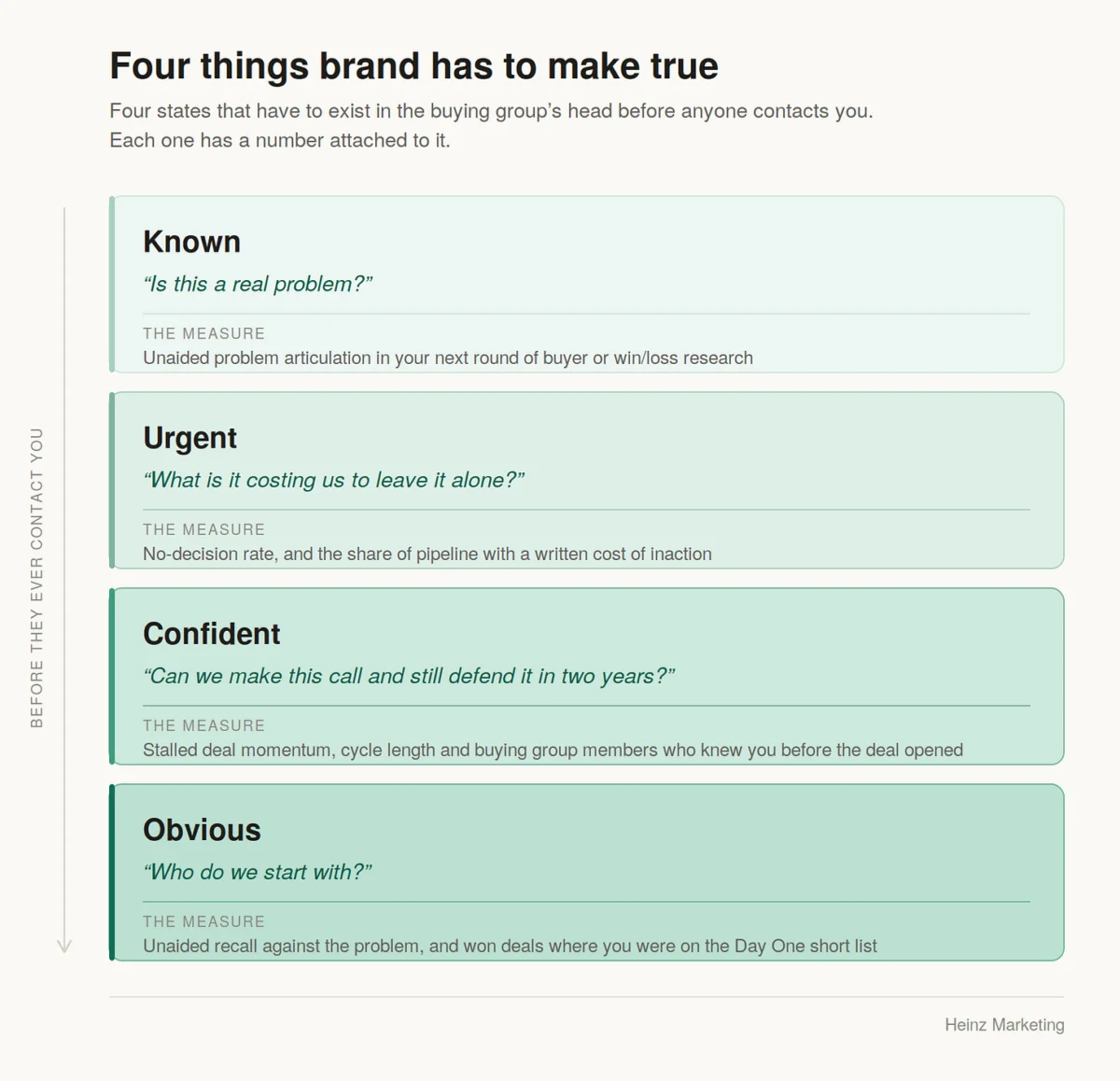
To bridge the gap between abstract brand concepts and concrete financial justification, a new framework has emerged that reframes brand not as a set of activities, but as four measurable states of buyer awareness. This approach allows CMOs to articulate and defend brand investments to CFOs by providing quantifiable metrics that can be tracked and influenced. The four essential states are: Known, Urgent, Confident, and Obvious.
Known: Does the Buying Group Understand the Problem?
The foundational element of brand perception is whether the target audience recognizes and articulates the problem that a product or service solves. This aligns with the principles of category design, which emphasizes educating the market about a specific idea or problem. Legendary companies, as described by thought leaders like Christopher Lochhead, succeed by shaping market understanding and winning when their perspective is widely accepted.
In today’s digital-first environment, this education often occurs independently of direct vendor involvement, through analysts, peer networks, online communities, search engines, and increasingly, advanced AI models. Thought leadership, when genuinely high-quality, plays a crucial role here. Research from Edelman and LinkedIn indicates that 79% of individuals who influence purchases, even if not formally on a stakeholder map, are more likely to champion proposals from companies whose thought leadership they regularly consume. Furthermore, 53% of respondents in this survey agreed that when thought leadership is truly high-quality, brand recognition becomes less critical.
The Measure: The key metric here is unaided problem articulation. This can be assessed through buyer or win/loss research by asking individuals to describe the problem in their own words before any vendor-specific information is presented. The percentage of respondents who articulate the problem in a manner consistent with the company’s category or thought leadership provides a tangible brand metric. This metric can be directly influenced by content strategies and can be used to estimate the potential market and future pipeline impact.
Urgent: What is the Cost of Inaction?
A problem that is recognized but not perceived as urgent is prone to indefinite deferral, a primary cause of lost deals. Matt Dixon and Ted McKenna, in their book "The JOLT Effect," highlight that between 40% and 60% of deals are lost to customers who express intent to buy but ultimately fail to act. Of these "no-decision" losses, 56% stem from customer indecision rather than a conscious preference for the status quo.
While B2B marketers are often adept at presenting the value of their solutions, they frequently struggle to effectively communicate the cost of not changing. Traditional "cost-of-inaction" slides in sales decks are often unconvincing and fail to drive the necessary urgency.
The Measure: The relevant metrics here are the no-decision rate and the proportion of the sales pipeline where a quantified cost of inaction is formally documented. These data points should ideally be captured within the CRM system. If not, their inclusion in win/loss analyses is essential for understanding the impact of urgency on deal progression.
Confident: Can Buyers Act Without Negative Repercussions?
This state addresses the crucial element of decision confidence. Gartner research indicates that customers with high decision confidence are ten times more likely to make a high-quality, low-regret purchase. Brent Adamson, co-author of "The Framemaking Sale," posits that the most significant driver of purchase likelihood in B2B sales is the degree to which customers feel confident in their own decisions. As Mimi Turner of LinkedIn observes, buyers prioritize decisions they can defend in the long term, even if circumstances change.
Confidence is not an individual attribute but a collective one within a buying team. A 2025 Gartner sales survey of 632 B2B buyers revealed that 74% of buying teams experienced unhealthy conflict during the decision-making process. Content tailored to the entire buying group, rather than hyper-personalized content that focuses on individual relevance without shared context, has been shown to improve consensus by approximately 20%, while individual-focused content can negatively impact it by 59%.
The Measure: Key indicators of confidence include the stalled and no-decision rates, sales cycle length, and the number of individuals within a closed-won buying group who had prior engagement with the company before the deal officially opened. These metrics provide insights into the ease and certainty with which buying groups can move forward.
Obvious: When Buyers Think of the Problem, Do They Think of You?
This final state relates to mental availability – the degree to which a brand is top-of-mind when a buyer encounters a specific problem. This has implications for both customer acquisition and retention. Research from the Ehrenberg-Bass Institute, surveying U.S. business insurance buyers across 17 product types, found that for each additional category entry point a customer associates with a brand in their memory, the probability of defection decreases by approximately 5%. Larger brands not only possess more customers but also have customers who connect them to a wider array of buying situations.
It is crucial to distinguish "obvious" from simply declaring oneself a market leader. Newer buyer research consistently shows that self-proclaimed category leadership is less effective than relational proof, such as peer recommendations and evidence from similar companies. The objective is to be the brand that surfaces when a specific problem arises, a more focused and achievable goal than seeking broad market leadership.
The Measure: The primary metrics are unaided recall against a problem statement (distinct from recall against a category name) and the percentage of closed-won deals where the company was on the initial shortlist before any contact was made. This latter metric is often available within CRM systems but is rarely reported.
Implications for Budgeting and Strategic Planning
This four-state framework offers a compelling alternative to the vague "invest in brand" narrative that often falls flat with CFOs. Instead, it presents brand as a series of measurable, progressive states of buyer awareness, prioritization, and association that can be influenced through targeted strategies.
The advantage of this approach lies in its ability to move beyond the "brand is a long-term investment" conversation, which CFOs often interpret as a request for spending without clear accountability or timeline. The new narrative, grounded in the reality that 90% of winners are already on the initial shortlist, allows marketers to demonstrate their ability to get on that list through tangible brand-building efforts.
While acknowledging that these metrics are leading indicators and may not provide perfect attribution – for instance, a no-decision rate can be influenced by sales enablement improvements, and unaided recall can shift due to competitor spending – they offer a far more robust basis for discussion than current methods.
For added CFO confidence, organizations can establish baseline measurements for all four brand stages before seeking budget allocation. It’s important to note that "Known" and "Obvious" are memory-based and tend to shift over quarters, while "Urgent" and "Confident" can demonstrate faster movement within active deals. Therefore, focusing initial budget requests on the latter two can yield more immediate, visible results, justifying further investment.
Ultimately, programs that survive budget scrutiny are those that can demonstrate tangible impact on metrics that resonate outside the marketing department. Those that rely solely on assertions of importance are more vulnerable to cuts. While this framework may not be inherently "sexy," it offers a pragmatic path toward securing sustained funding for essential brand-building initiatives.
The Enduring Value of "Brand"
While the impulse to rename "brand" to "demand creation" is understandable, driven by the immediate need for budget approval and a focus on quarterly results, this linguistic maneuver ultimately obscures the mechanism behind demand. "Demand creation" describes the output, but not the process, leading to its measurement and judgment based on short-term cycles, precisely the trap the rename intended to escape.
Six months into a "demand creation" initiative, questions about immediate pipeline generation are inevitable. Brand-building, which operates on the timescale of buying cycles, risks losing this argument.
Brand, at its core, is about being known and understood as the most credible solution to a buyer’s pressing problem, by all key decision-makers. This fundamental role does not diminish when the word itself is replaced; it simply becomes more challenging to communicate to those who provide the essential funding. By re-establishing brand as a measurable set of buyer states, B2B marketers can reclaim its strategic importance and secure the resources necessary to build lasting market influence.