The landscape of commerce has been in a perpetual state of evolution, dramatically shifting from localized brick-and-mortar establishments to expansive, internet-driven e-commerce platforms that transcend geographical boundaries. Now, a new paradigm is emerging, poised to once again redefine how consumers discover, evaluate, and purchase goods: agentic commerce. This nascent model leverages advanced artificial intelligence (AI) agents to act autonomously on behalf of consumers, streamlining the entire purchasing journey from initial intent to post-transaction support.
This transformative shift, while generating considerable excitement across the retail and technology sectors, also brings forth a cascade of critical questions. Will consumers wholeheartedly entrust AI agents with significant buying decisions and sensitive financial information? Can businesses justify the substantial investments required for integration and optimization, ensuring a measurable return? Fundamentally, does autonomous shopping genuinely address existing friction points in the consumer journey, or does it risk introducing new layers of complexity and ethical dilemmas? Despite these uncertainties, the underlying AI technology is progressing at an unprecedented pace, rapidly turning what once seemed like science fiction into a tangible reality. The vision of a shopping experience where consumers are liberated from endless tab-hopping, meticulous product comparisons across disparate websites, and exhaustive manual research is now within reach, as AI agents are increasingly capable of understanding nuanced intent, evaluating myriad options, comparing prices dynamically, and executing purchases within predefined parameters.
Understanding Agentic Commerce: A Digital Proxy for Shoppers
At its core, agentic commerce defines a retail model where AI agents function as sophisticated decision-makers, operating directly on behalf of the customer. Unlike traditional e-commerce, where consumers actively engage in every step—from manually searching and filtering products to comparing options and completing transactions—agentic commerce empowers AI agents to manage these laborious tasks based on the user’s expressed intent, personal preferences, budgetary constraints, and overarching buying objectives.

To illustrate this concept practically, Alex Moss, a prominent voice in the field, described agentic commerce in the “SEO Unplugged: Agentic Commerce with Alex Moss” podcast: “So everything’s connected. I could literally say into the into a phone to my agent, go and buy me some new shoes with that jacket I bought last week, and that’s it. And it would go away. It would do the research. And of course, you can have a say in an approval in terms of part of the journey.” This anecdote perfectly encapsulates the essence of agentic commerce: a digital shopping proxy where human users define the ultimate goal, and AI agents meticulously execute the underlying processes. Crucially, while the AI shoulders the heavy lifting, the human user retains ultimate control over the final decision-making process through approval mechanisms and predefined rules.
The Inevitable Shift: Why Agentic Commerce is the Next Frontier
The notion of agentic commerce, while still futuristic for many, is no longer a distant concept but an unfolding reality. A confluence of evolving consumer behavior, accelerated AI adoption, and robust industry forecasts unequivocally signals a future where AI agents become indispensable participants in the buying journey. Statistical data underscores this impending transformation:
-
Pervasive AI in Consumer Buying Journeys: Consumers are already integrating AI-powered tools into their product discovery and decision-making processes. A comprehensive report by McKinsey & Company reveals that over 70% of AI-powered search users initiate their queries with top-of-the-funnel questions concerning product categories, specific brands, or services. The same report found that nearly 50% of consumers actively utilize AI-powered search experiences today. This growing reliance on AI for initial research and guidance suggests a significant disruption to traditional search-driven traffic, with the study projecting that businesses could experience a 20–50% shift of their traffic away from conventional search experiences over time. This indicates a profound change: consumers are transitioning from merely searching for information to actively soliciting AI systems to inform and guide their purchasing decisions.
-
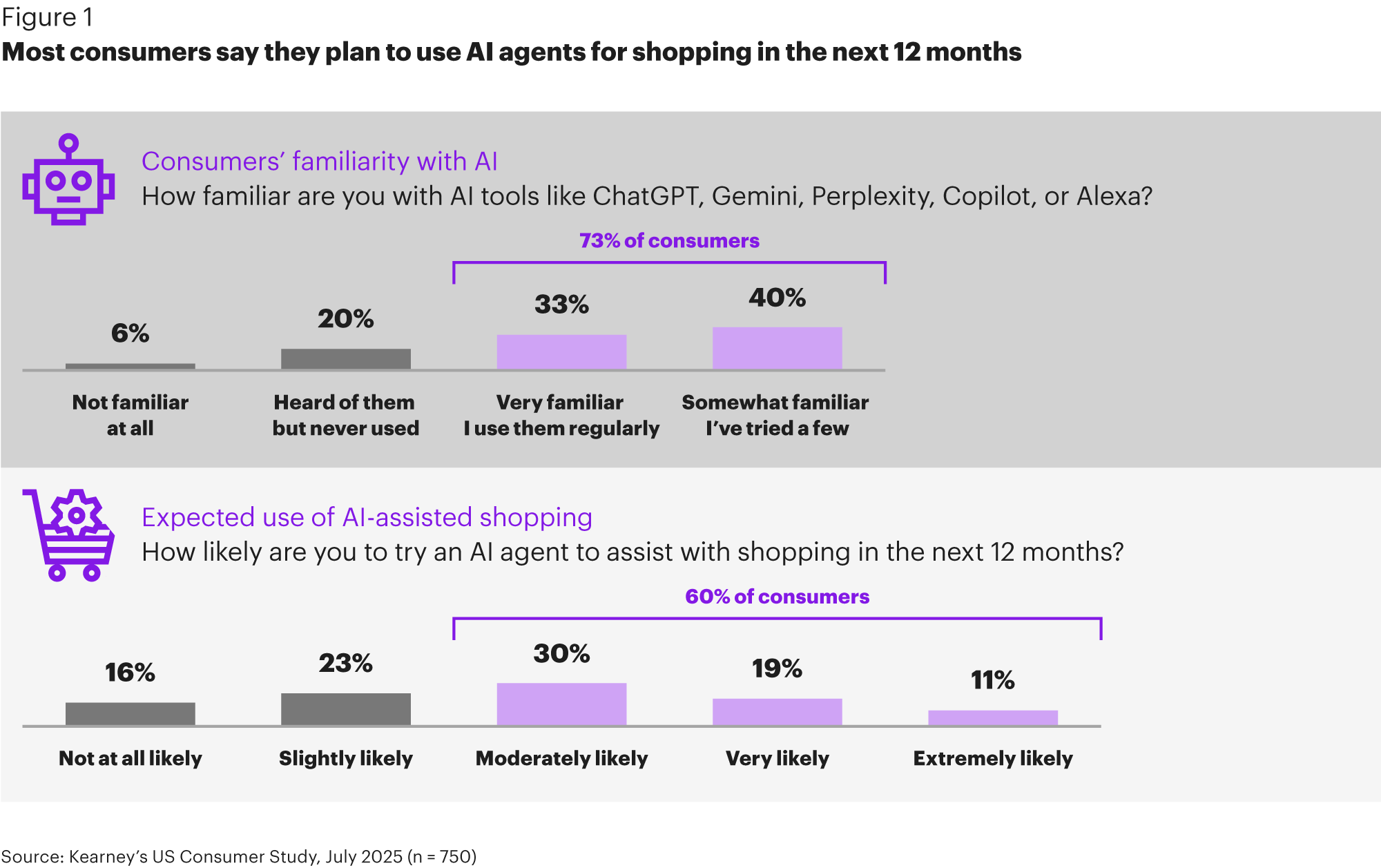
Rising Consumer Expectation for Agentic Experiences: The demand for AI-assisted shopping is escalating rapidly. The 2025 Kearney report, “Agentic Commerce: From Brand Loyalty to Bot Logic,” delved into consumer sentiment regarding AI agents in retail. The findings were striking: over 60% of shoppers anticipate using agentic AI by 2026. The report also highlighted a major behavioral shift, indicating that consumers increasingly prioritize convenience, speed, competitive pricing, and trust over traditional platform loyalty. Instead of browsing individual retailer applications, consumers are expected to rely on AI agents capable of cross-platform product comparison, review analysis, optimal deal identification, and efficient purchase completion. This dynamic fundamentally alters the competitive landscape, transitioning from direct retailer-versus-retailer competition to a more intricate, AI-driven discovery ecosystem.

-
Explosive Growth Predicted by Analysts: Industry analysts foresee agentic commerce as a monumental economic opportunity in the coming years. Another McKinsey report emphasizes that agentic commerce possesses the potential to fundamentally reshape the entire shopping experience. Based on the accelerating adoption of AI-powered discovery tools and increasing merchant readiness, the report estimates that by 2030, the U.S. B2C retail market alone could unlock an orchestrated revenue opportunity ranging from $900 billion to $1 trillion. Globally, this opportunity is projected to expand significantly, reaching between $3 trillion and $5 trillion.
The Operational Blueprint: How Agentic Commerce Functions
Fundamentally, agentic commerce operates by synergizing human intent with AI-driven execution. Instead of manual website navigation, product comparison, and purchase initiation, users delegate a substantial portion of the shopping journey to AI agents. These intelligent agents are equipped to comprehend user goals, meticulously evaluate options, make informed decisions within predefined constraints, and even execute transactions on the user’s behalf. What distinguishes this from conventional AI assistants is the agent’s capacity for independent action. While assistive AI tools primarily furnish information or recommendations, agentic AI can autonomously perform tasks across the entire shopping journey.
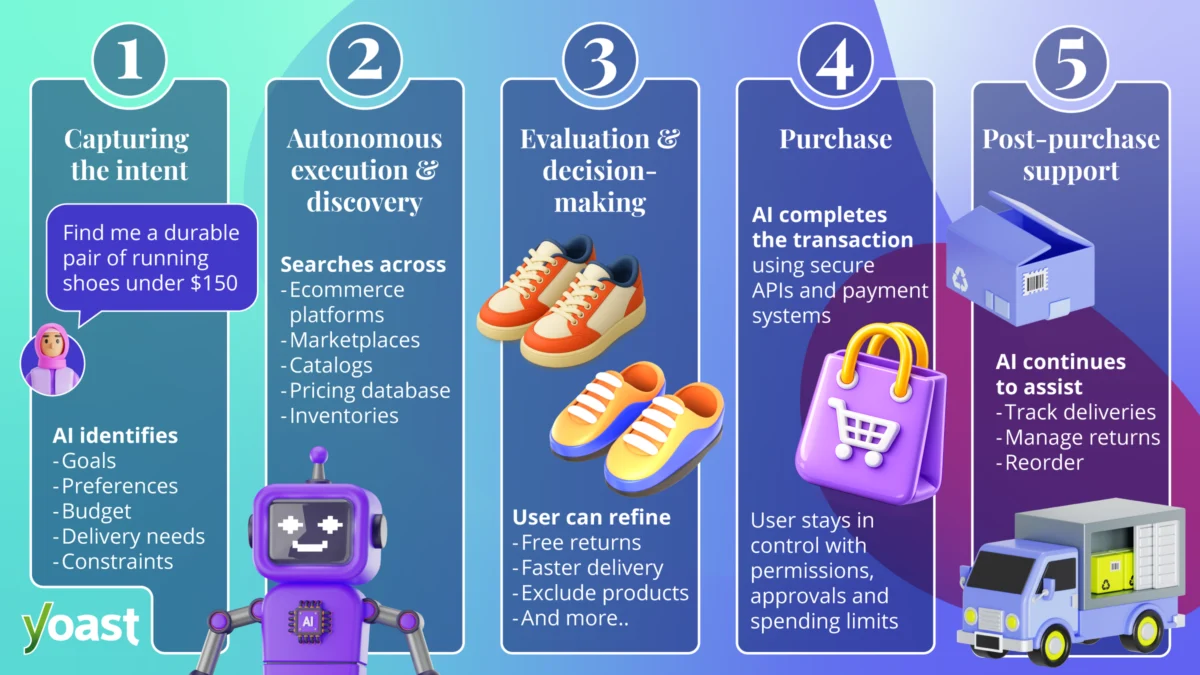
Here’s a detailed, step-by-step breakdown of how agentic commerce typically works:
-
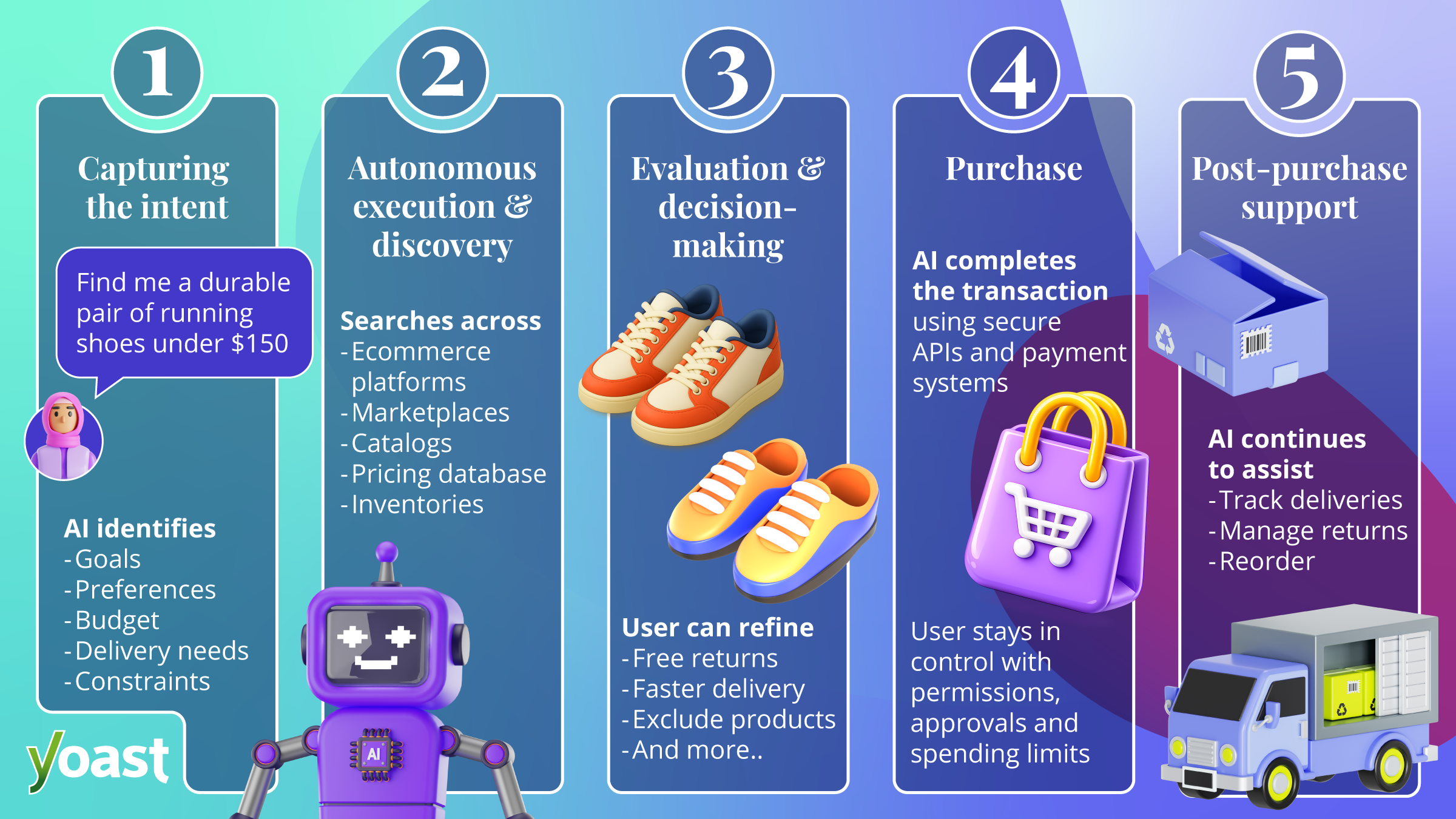
Capturing the Intent: Every agentic commerce interaction commences with a clearly defined intent. Rather than inputting succinct keywords into a search bar, users engage with AI agents through conversational interfaces, leveraging natural language processing (NLP). For example, a shopper might articulate: “Find me a sustainable, ethically sourced coffee maker under $150 that brews quickly and is easy to clean,” or “Plan a weekend getaway for two to a beach destination in September, including flights and a boutique hotel, within a $2,000 budget.” At this initial stage, the AI agent’s primary objective is to thoroughly understand the user’s goals, specific preferences, budget limitations, delivery expectations, and any other pertinent constraints. If the initial request appears overly broad or ambiguous, the agent will typically ask clarifying follow-up questions to refine the intent before proceeding.
-
Autonomous Instruction Execution and Brand Discovery: Once the user’s intent is sufficiently clear, the AI agent autonomously commences the task execution. Instead of confining its search to a single website, it simultaneously scans and synthesizes information from a vast array of e-commerce platforms, online marketplaces, extensive product catalogs, customer reviews, dynamic pricing databases, and real-time inventory systems. This is where agentic commerce fundamentally diverges from traditional product discovery. Rather than presenting an overwhelming deluge of product pages, the agent intelligently curates and narrows down the most relevant options based on the shopper’s precise needs and parameters. Critically, brands that possess well-structured product data, accurate and real-time inventory information, transparent pricing models, and machine-readable content are significantly more likely to be discovered and prioritized by these AI agents. This new dynamic underscores the growing importance of data quality and discoverability in the age of AI.
-
Evaluation and Decision-Making: After aggregating a diverse set of options, the AI agent embarks on a rigorous evaluation process, comparing various products and analyzing their respective trade-offs. It meticulously analyzes factors such as product specifications, brand reputation, aggregated customer reviews and ratings, warranty details, pricing across multiple vendors, delivery options and timelines, return policies, and the overall value proposition. Beyond merely listing products, the agent engages in a form of reasoned analysis, explaining why certain products align more closely with the shopper’s stated requirements than others. Users possess the flexibility to further refine the decision-making process by introducing additional conditions, such as: “Prioritize options with a minimum 4.5-star rating,” “Find the same item but from a brand committed to carbon neutrality,” or “Only show products available for next-day delivery.” This iterative process establishes a crucial feedback loop, enabling the AI agent to continuously enhance its recommendations based on evolving user preferences and explicit directives.
-
Seamless Purchase: Upon the shopper’s approval of a selected product or the activation of predefined purchasing rules, the AI agent is empowered to proceed with the transaction. Utilizing secure APIs, established commerce protocols, and robust payment systems, the agent can seamlessly add items to virtual shopping carts, apply eligible discounts, authenticate payments, and finalize purchases. In certain scenarios, the purchase may occur instantaneously. In others, the AI agent might be programmed to await specific conditions—such as a price drop, renewed stock availability, or the emergence of faster delivery options—before completing the transaction. It is paramount that, even though the AI manages the execution, users maintain full control through configurable permissions, approval settings, and defined spending limits, ensuring a secure and user-centric experience.
-
Post-Purchase Support: The role of AI agents extends beyond the point of checkout, encompassing comprehensive post-purchase experiences. AI agents can continue to assist users by proactively tracking order status and delivery updates, initiating and managing product returns or exchanges, facilitating warranty registrations, providing intelligent troubleshooting support, and even monitoring product performance to suggest timely reorders for consumables or maintenance. This transforms shopping from a series of discrete, one-time transactions into an ongoing, intelligent, and highly personalized experience.
Technological Pillars: The Protocols and Platforms Driving Agentic Commerce
Agentic commerce is not solely a product of advanced AI models; it is underpinned by a rapidly evolving ecosystem of interoperable protocols, robust frameworks, secure APIs, and sophisticated payment systems. These foundational technologies enable AI agents to interact seamlessly, securely, and efficiently with diverse digital commerce platforms.
A pivotal concept influencing agentic AI, and by extension, agentic commerce, is the Model Context Protocol (MCP). MCP facilitates AI models’ connection with external systems, tools, databases, and applications through a standardized communication layer. This negates the need for bespoke integrations for every AI model and software platform, instead creating a common framework for consistent information access and action execution. As agentic commerce crystallizes as a significant use case for agentic AI, specialized commerce-focused protocols are emerging to address the unique requirements of shopping ecosystems, enabling AI agents to interpret product information, engage with merchants, compare inventory, and securely process transactions.
Key technological developments supporting this evolution include:
-
Agentic Commerce Protocol (ACP): Spearheaded by Stripe in collaboration with OpenAI, the Agentic Commerce Protocol (ACP) stands as a foundational open standard. Its primary objective is to enable AI agents to interact more intuitively and effectively with e-commerce systems. ACP establishes a standardized framework for product discovery, checkout processes, and payment execution. In essence, it provides the critical infrastructure that allows AI agents to transcend mere product recommendations and actively complete secure purchases directly on behalf of users. Still in its nascent stages, ACP has already seen real-world implementation. For instance, ChatGPT users in the United States can now purchase products directly from Etsy merchants within the conversational interface, facilitated by Stripe’s checkout technology. Integrations with Shopify are also anticipated. This development signifies a crucial shift from AI-assisted discovery to fully AI-enabled transactions occurring within conversational environments, thereby streamlining the entire shopping journey by minimizing redirects and making it inherently more “agent-friendly.” ACP’s open-standard approach is particularly noteworthy, fostering broad adoption across developers, merchants, and e-commerce platforms, positioning it as a cornerstone for future AI-driven shopping experiences.
-
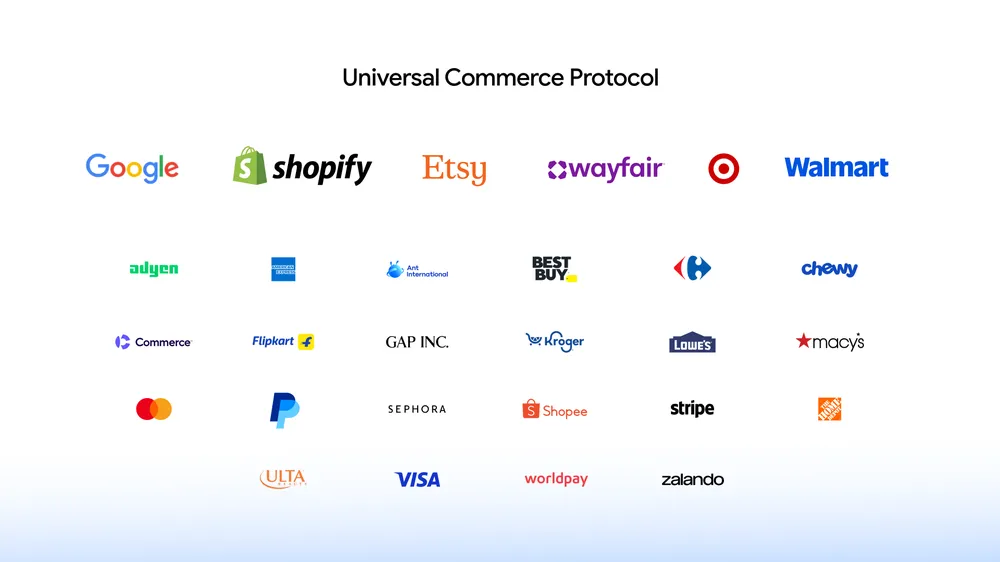
Universal Commerce Protocol (UCP): As the proliferation of AI agents in the shopping journey accelerates, a significant challenge emerges: how can these agents communicate effectively and securely with a multitude of retailers, marketplaces, payment providers, and service platforms without requiring a custom integration for each entity? The Universal Commerce Protocol (UCP), introduced by Google, is designed to directly address this complexity. UCP is an open standard aimed at establishing a common language for agentic commerce, providing a shared framework that enables AI agents and commerce platforms to communicate more efficiently across the entire shopping lifecycle. Imagine millions of AI agents simultaneously researching products, checking inventory, comparing prices, placing orders, and managing returns daily. Without a standardized framework, the logistical burden of countless one-to-one integrations would be insurmountable for retailers and AI platforms alike. UCP seeks to mitigate this complexity by providing a unified set of rules for the seamless exchange of commercial information among all participants. What sets UCP apart is its expansive scope. Unlike protocols focused primarily on purchasing, UCP is engineered to support the complete commerce lifecycle, encompassing product discovery, ordering, fulfillment, returns, and customer service. Google has meticulously designed UCP for interoperability with other emerging AI standards, including Agent2Agent (A2A), Agent Payments Protocol (AP2), and Model Context Protocol (MCP), allowing businesses to adopt agentic commerce without necessitating a complete overhaul of their existing systems. The initiative boasts substantial industry backing, with Google co-developing UCP alongside major commerce entities such as Shopify, Etsy, Wayfair, Target, and Walmart, and garnering support from payment giants like Mastercard, Visa, Stripe, and American Express. UCP represents a critical step towards an ecosystem where AI agents, merchants, and payment providers can operate within a cohesive framework, providing the foundational infrastructure for scalable agentic commerce across the broader digital economy.

-
Mastercard Agent Pay: While ACP and UCP address communication and interoperability, Mastercard Agent Pay tackles one of agentic commerce’s most vital challenges: ensuring trust and secure payment execution. As AI agents gain the capability to discover products, compare options, and make purchasing decisions, a secure mechanism for completing transactions on behalf of users becomes indispensable. Mastercard Agent Pay was specifically introduced to provide this crucial payment infrastructure. The platform is designed to facilitate payment execution by AI agents, strictly adhering to user-defined permissions, authentication requirements, and spending controls. Rather than granting AI systems unfettered access to payment credentials, Agent Pay prioritizes the creation of verified, traceable, and authorized payment flows for agent-driven commerce. A significant development in this area is Mastercard’s collaboration with PayPal, integrating Agent Pay into PayPal’s extensive wallet infrastructure. This integration enables AI agents to securely complete transactions on behalf of PayPal users, while maintaining the robust security and trust mechanisms consumers have come to expect from digital payments. This partnership is pivotal, moving agentic commerce beyond experimental AI environments into a much larger ecosystem of merchants, consumers, and established payment networks, thereby accelerating real-world adoption.
Together, ACP, UCP, and Agent Pay are meticulously laying the groundwork for agentic commerce. ACP focuses on enabling AI agents to engage with merchants and finalize purchases, while UCP establishes a common language for agents, retailers, and platforms to operate together at scale. Agent Pay adds the indispensable layer of trust by ensuring secure, authorized payments, collectively propelling AI-driven shopping closer to widespread reality.
Challenges and Unanswered Questions in the Agentic Future
Despite the rapid technological advancements and the clear potential of agentic commerce, its widespread adoption is far from assured. A number of significant hurdles and unanswered questions persist. Many consumers may harbor reservations about ceding decision-making authority to AI agents or granting them access to sensitive payment methods. Concerns around privacy, data security, and the potential for algorithmic bias in recommendations are legitimate and must be addressed with robust safeguards. Furthermore, some may question whether autonomous shopping truly solves a fundamental problem or simply facilitates more frequent and potentially impulsive purchasing.
Businesses, too, face their own set of uncertainties. Embracing agentic commerce will necessitate substantial investments in new protocols, the standardization of structured data, complex integrations, and the re-engineering of commerce experiences to be AI-ready. The return on these investments remains unclear, particularly given that broad consumer adoption is still in its nascent stages. There are also broader implications to consider, such as the potential for increased fraud vectors, platform dependency risks, and the erosion of direct relationships between brands and their customers. As AI agents intermediate the shopping process, maintaining brand loyalty and fostering direct engagement could become more challenging.
Agentic commerce undeniably represents an exciting and potentially transformative direction for digital shopping. However, its long-term success will hinge not only on technological prowess but also on its ability to demonstrably create tangible value for consumers, merchants, and the broader e-commerce ecosystem, extending beyond the immediate interests of the AI platforms powering this revolution. Addressing these critical questions with transparency, ethical design, and a clear focus on user benefits will be paramount to realizing the full promise of an agentic future.