The pervasive influence and transformative potential of artificial intelligence (AI) have positioned it as a dominant discourse across industries, captivating the attention of technologists, business leaders, and the general public alike. In particular, the marketing sector is witnessing a rapid integration of AI, with a significant portion of professionals already leveraging its capabilities or planning to do so in the near future. Recent surveys indicate that 39% of email marketers are actively using AI tools, while an additional 25% are in the planning stages of adoption. This widespread interest necessitates a clear understanding of AI’s fundamental classifications, from its evolutionary stages to its functional types and specialized fields, to navigate its current applications and anticipate its future trajectory.
The Foundational Divide: Narrow vs. Strong AI
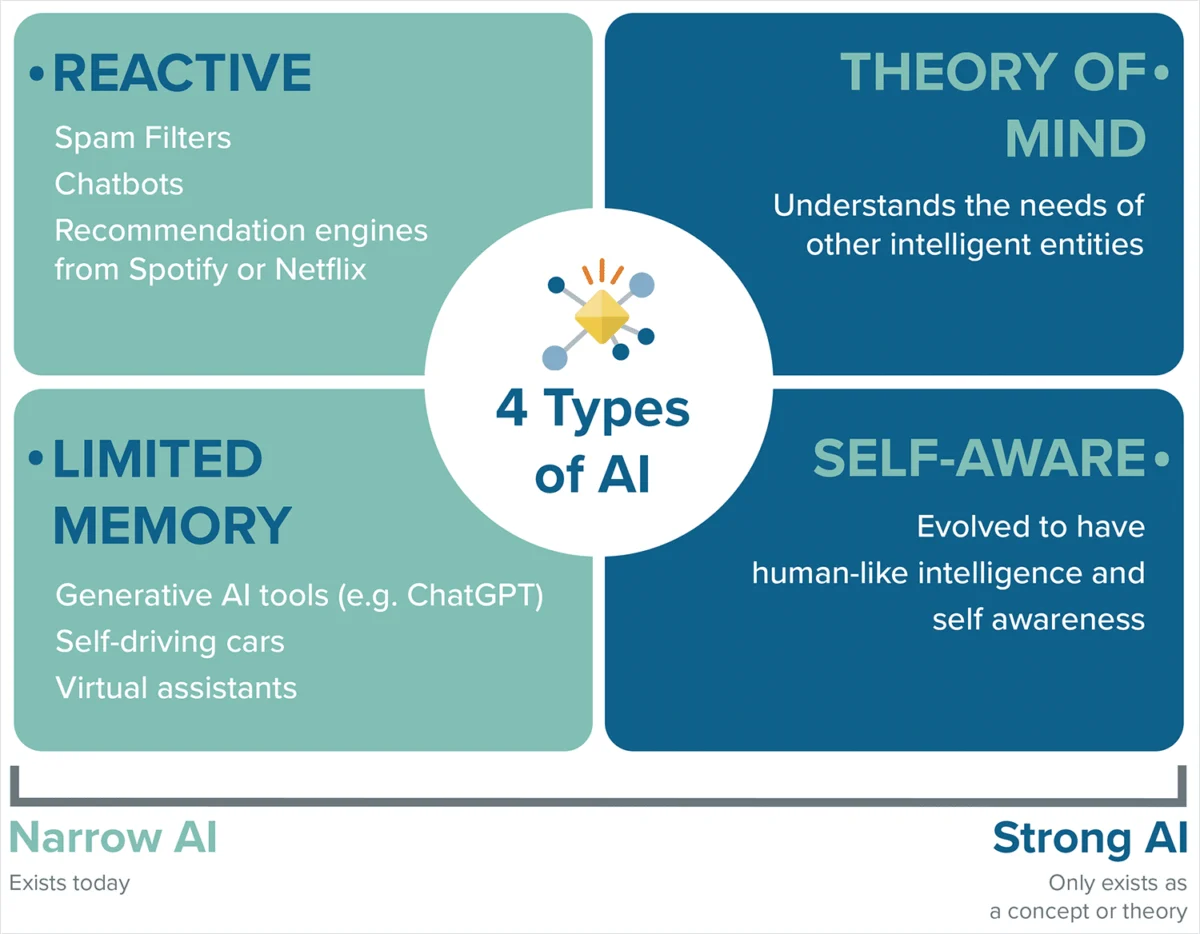
Before delving into the specific types of AI, it is crucial to establish the overarching stages that delineate AI’s current state from its theoretical aspirations. AI systems are broadly categorized into two primary stages: Narrow AI and Strong AI.
Narrow AI, often referred to as Weak AI, represents the entirety of artificial intelligence that exists today. It encompasses systems designed and trained for a specific task or a narrow range of tasks. These systems operate within predefined parameters, excelling at their designated functions but lacking generalized cognitive abilities, consciousness, or self-awareness. Examples range from simple rule-based systems to complex machine learning models that can perform highly sophisticated analysis or generation within their domain. The AI applications we interact with daily—from recommendation algorithms to voice assistants—all fall under the umbrella of Narrow AI.
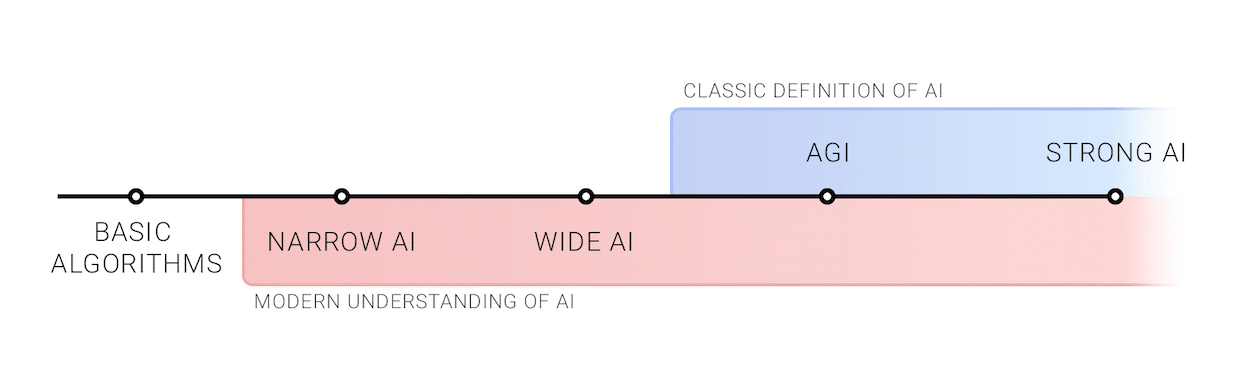
In stark contrast, Strong AI, also known as Artificial General Intelligence (AGI), remains a conceptual and theoretical construct. Strong AI refers to systems that possess human-level cognitive abilities, including consciousness, self-awareness, the capacity for abstract thought, problem-solving across diverse domains, and the ability to learn from experience in a general sense, much like a human. This stage of AI would involve genuine understanding, emotion, and potentially, free will. Achieving Strong AI is considered the ultimate goal for many AI researchers, but it is a challenge that has yet to be overcome and is widely believed to be decades, if not centuries, away. The distinction between Narrow and Strong AI is fundamental because the four functional types of AI discussed subsequently are not equally distributed across this spectrum. The first two types fall squarely within Narrow AI, while the latter two represent theoretical leaps towards Strong AI.

Deconstructing AI: The Four Functional Types
Beyond these broad stages, AI can be further categorized into four main types based on their functionality and cognitive capabilities. This classification offers a more granular understanding of how AI systems operate and what they are capable of achieving.
1. Reactive Machines: The Earliest Form of Intelligence
Reactive AI algorithms are the most basic and oldest forms of AI systems. Their core characteristic is the ability to respond to various inputs without any memory-based functionality. This means they cannot learn from past experiences or use historical data to inform future decisions. Each interaction is treated as a new, independent event. Reactive machines perceive their current environment directly and execute a predefined response based on the data presented to them in that moment. They lack the capacity for anticipating future actions or understanding context beyond their immediate perception.
A classic historical example of reactive AI is IBM’s Deep Blue, the chess-playing computer that famously defeated Garry Kasparov in 1997. Deep Blue could analyze the chess board and evaluate millions of potential moves per second, but it had no memory of past games played against Kasparov or any other opponent. Its “intelligence” was purely reactive to the current state of the board. Other contemporary examples include simple spam filters that identify keywords or patterns in emails to flag them, or basic recommendation systems that suggest products based solely on an item’s current popularity. While limited, reactive AI forms the fundamental building block for more advanced systems and continues to play a role in specific, constrained applications where memory is not required. However, its inherent inability to learn or adapt highlights the driving force behind research into more sophisticated AI types.
2. Limited Memory AI: The Engine of Modern Applications
The next evolutionary step in AI functionality is Limited Memory AI. These systems encompass all the capabilities of reactive AI but add the crucial ability to temporarily store data from past experiences. This short-term memory allows them to leverage historical data, albeit for a limited duration, to make more informed decisions. The “memory” is typically not permanent or generalized knowledge but rather a specific dataset collected for a particular task over a finite period.
Limited Memory AI powers a vast array of contemporary AI applications that are integrated into our daily lives. Self-driving cars, for instance, utilize limited memory to observe the speed and direction of other cars, track lane markings, and monitor traffic lights for a few moments to make safe and dynamic driving decisions. Virtual assistants like Siri or Alexa store fragments of conversational context to provide more coherent responses within a single interaction. Recommendation engines on e-commerce platforms or streaming services analyze a user’s recent viewing or purchasing history to suggest relevant content or products. Chatbots, particularly those powered by machine learning, learn and improve their responses over time by drawing from past conversations and user interactions, though their memory is typically confined to the scope of their training data and recent dialogue. Generative AI models, such as those used for creating text (like ChatGPT) or images (like Midjourney), also fall under Limited Memory AI. They are trained on massive datasets and use this “learned” information to generate new content, effectively remembering patterns and structures from their training, but they do not possess genuine understanding or continuous, self-improving memory beyond their training cycles. This category represents the current cutting edge of deployable AI technology.
3. Theory of Mind AI: The Path Towards Emotional Intelligence
Moving into the realm of Strong AI, Theory of Mind AI refers to hypothetical algorithms capable of understanding and attributing mental states—beliefs, desires, intentions, emotions—to the entities they interact with, including humans and other AI systems. This would be a monumental leap, enabling AI to comprehend not just what someone says or does, but why they say or do it, and to predict behavior based on inferred emotional and cognitive states. Such systems would make decisions based on an understanding and remembrance of emotions, adapting their behavior accordingly during interactions, paving the way for truly emotionally intelligent robots and conversational agents.
Full development of Theory of Mind AI faces immense challenges due to the inherent complexity and subtlety of human communication, where behavior rapidly adapts to shifting emotions, social cues, and unspoken context. Researchers are making incremental progress in areas like sentiment analysis and emotion recognition, but achieving genuine understanding and the ability to model complex human psychology remains elusive. Early experimental AI projects like Kismet from MIT’s AI Lab demonstrated machines that could recognize and simulate basic emotions, but these were largely rule-based and lacked true understanding. More recently, advanced conversational AI aims to simulate empathy, but this is still a programmed response rather than genuine emotional intelligence. Overcoming the hurdle of enabling AI to truly understand and comprehend, rather than merely process and generate, is a significant step Theory of Mind AI aims to achieve.
4. Self-Aware AI: The Ultimate Frontier
Self-Aware AI stands as the most advanced and purely theoretical type of AI, representing the pinnacle of Strong AI. As the name suggests, this refers to an AI that has evolved to possess human-level consciousness, self-awareness, and a sense of self. It would not only understand and attribute mental states but would also possess its own mental states, including consciousness, beliefs, desires, and intentions. This level of AI would be capable of experiencing emotions, having subjective experiences, and potentially even exhibiting free will, akin to the sentient operating system “Samantha” in Spike Jonze’s film Her.
Achieving Self-Aware AI is considered the ultimate, long-term goal for many in the field, yet it remains firmly within the realm of science fiction for the foreseeable future. Experts widely believe that humanity is still decades, if not centuries, away from developing such a system. The philosophical and ethical implications of creating self-aware machines are profound, raising questions about rights, responsibilities, and the very nature of consciousness. While it serves as an aspirational benchmark for AI development, the focus of current research and practical application remains firmly rooted in the more tangible capabilities of Narrow AI.
Navigating the AI Ecosystem: Machine Learning, Deep Learning, and Generative AI
The broader landscape of AI is often discussed using terms like Machine Learning (ML), Deep Learning (DL), and Generative AI, which are frequently used interchangeably but represent distinct, hierarchical fields within AI. Understanding their relationships is crucial for grasping the nuances of modern AI applications.
Artificial Intelligence (AI) is the overarching concept, encompassing any technique that enables computers to mimic human intelligence. This includes everything from simple rule-based expert systems to complex neural networks.
Machine Learning (ML) is a subset of AI. It involves algorithms that allow systems to learn from data without being explicitly programmed. Instead of following rigid instructions, ML models identify patterns and make predictions or decisions based on the data they are trained on. This learning process typically involves identifying relationships within datasets and continuously refining these relationships as more data becomes available.
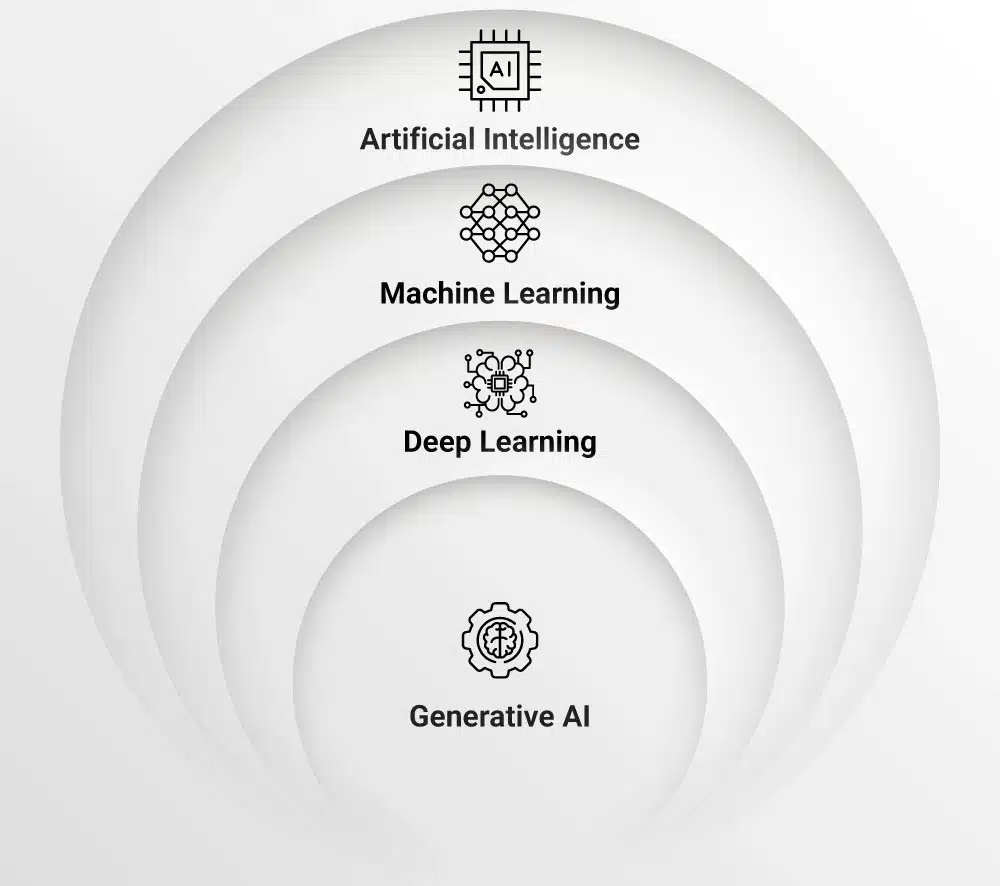
Deep Learning (DL) is a specialized subset of Machine Learning. It utilizes artificial neural networks with multiple layers (hence “deep”) to learn complex patterns from vast amounts of data. Inspired by the structure and function of the human brain, deep learning excels at tasks such as image recognition, speech recognition, and natural language processing, often outperforming traditional machine learning methods in these areas due to its ability to automatically discover intricate features within raw data.
Generative AI is a further specialized subset that typically leverages deep learning techniques. It focuses on creating new, original content—such as text, images, audio, or code—that resembles the data it was trained on. Generative AI models learn the underlying patterns and structures of their input data and then use this knowledge to produce novel outputs. For this reason, Generative AI falls squarely under the Limited Memory AI type, as it relies on vast amounts of historical data (its training dataset) to generate new content, without possessing true understanding or consciousness. Popular tools like ChatGPT, which generate human-like text, and image generators like Midjourney or DALL-E, are prime examples of Generative AI in action. These tools have democratized access to sophisticated content creation, transforming workflows in various industries, including marketing.
AI’s Transformative Role in Marketing: Current Adoption and Future Potential
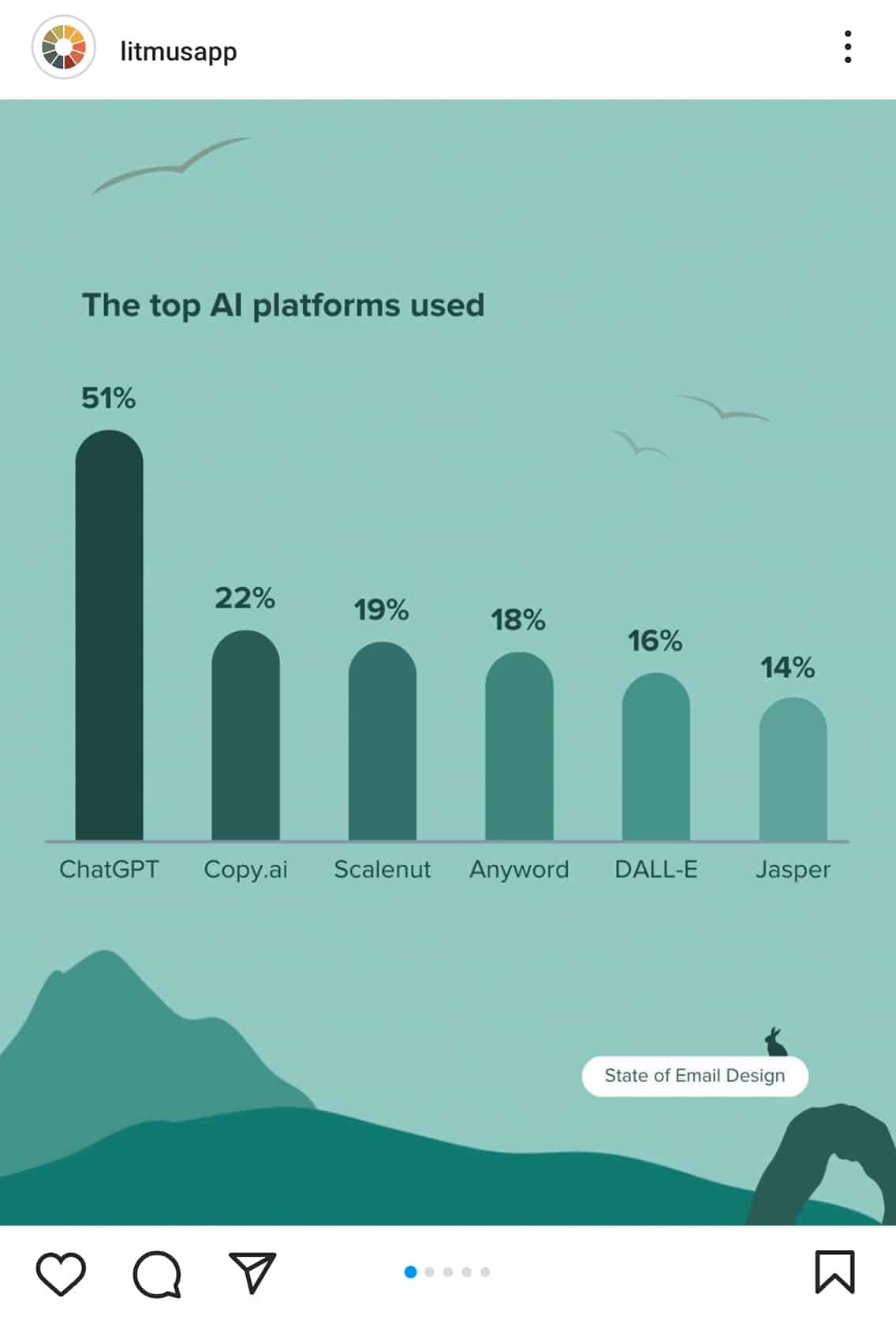
The marketing industry, particularly email marketing, has been quick to embrace the practical applications of Narrow AI. The 39% adoption rate among email marketers, with an additional 25% planning future use, underscores a significant shift towards AI-driven strategies. Current applications predominantly leverage Generative AI, a testament to its immediate utility in content creation. Data from Litmus’s 2023 State of Email Design report indicates that copy creation tools, especially conversational models like ChatGPT, are more popular than image-only tools. This reflects marketers’ immediate need to streamline the often time-consuming processes of drafting email copy, crafting compelling subject lines, and brainstorming campaign ideas.
However, while content creation is a vital aspect, it may not be the most significant bottleneck in email production cycles. The 2023 State of Email Workflows Report revealed that collecting feedback emerged as the single biggest obstacle and bottleneck. This presents a nuanced challenge for AI integration. While AI can generate content efficiently, the human element of review, approval, and iteration remains paramount, particularly in marketing where brand voice, legal compliance, and strategic messaging are critical. The apprehension around solely AI-generated copy suggests that while AI can assist, the final human touch is indispensable for ensuring quality and alignment.
Bridging the Gap: AI, Human Oversight, and Workflow Optimization
The current state of AI, primarily Limited Memory AI, necessitates a collaborative approach. AI tools can automate repetitive tasks, provide data-driven insights, and generate preliminary content, thereby freeing up human marketers to focus on higher-level strategic thinking, creativity, and relationship building. However, the human role in oversight, refinement, and final approval cannot be overstated, especially when dealing with brand reputation and customer communication.
The challenge of collecting feedback, as identified in the Litmus report, highlights a critical area where AI could potentially evolve to assist, not by replacing human judgment, but by facilitating the process. Imagine AI tools that could intelligently summarize feedback, identify conflicting comments, or even suggest revisions based on established brand guidelines and past successful campaigns. While AI-generated copy requires human review, the process of consolidating and acting upon diverse human feedback could be significantly optimized with intelligent assistance. Tools that centralize feedback and streamline communication, like Litmus Proof, are already addressing this, demonstrating the ongoing need for solutions that enhance human collaboration rather than replace it.
Ethical considerations also play a significant role. As AI becomes more sophisticated, issues of bias in training data, transparency in algorithms, and the potential for misinformation become increasingly important. Responsible AI development and deployment require continuous human vigilance and ethical frameworks to ensure that these powerful tools are used for good and do not inadvertently perpetuate harm or erode trust.
The Road Ahead: Strategic Implications for Business and Society
The journey from Reactive AI to the speculative future of Self-Aware AI is a testament to humanity’s relentless pursuit of understanding and replicating intelligence. Currently, we operate firmly within the realm of Narrow AI, with Limited Memory AI driving the most significant advancements and practical applications across industries. For businesses, and marketers in particular, a clear understanding of these distinctions is not merely academic; it is strategic. It allows for realistic expectations regarding AI capabilities, informs investment decisions, and guides the development of workflows that effectively integrate AI as a powerful assistant rather than a complete replacement.
The future of AI promises continued innovation, with ongoing research pushing the boundaries of machine learning, deep learning, and generative models. While the theoretical horizons of Theory of Mind and Self-Aware AI remain distant, the continuous refinement of Narrow AI will undoubtedly lead to more intuitive, personalized, and efficient tools. The focus will likely shift from merely generating content to enabling AI to understand complex contexts, anticipate needs, and facilitate human collaboration in increasingly sophisticated ways. The imperative for businesses is to stay informed, adapt proactively, and strategically leverage AI’s evolving capabilities to drive innovation, enhance productivity, and maintain a competitive edge in an increasingly intelligent world, always ensuring human oversight and ethical considerations remain at the forefront.