rifanmuazin
The digital inbox, a ubiquitous fixture of modern professional and personal life, frequently presents a formidable challenge: a relentless deluge of messages. For many, the first glance at a Monday morning inbox elicits a sigh, confronting a dozen new emails, most of which risk being ignored or relegated to a later, uncertain review. This common scenario underscores a critical truth in digital communication: timing matters profoundly. Hitting the ‘send’ button at the opportune moment can dictate whether a message receives immediate attention or becomes submerged beneath an endless stream of competing communications.
The quest for the ‘best time’ to send emails is a pervasive concern for marketers, businesses, and content creators alike. While a universal, one-size-fits-all answer remains elusive due to the diverse nature of audiences and objectives, extensive data analysis over years has revealed discernible trends. These trends offer invaluable guidance, helping senders reach their target audience when they are most receptive to opening, reading, and, crucially, acting upon an email’s content. Understanding these patterns, combined with personalized data insights, forms the bedrock of an effective email marketing strategy in an increasingly competitive digital landscape.
The Foundational Importance of Email Timing
Email marketing has evolved significantly since its inception, transforming from a novel communication channel into a sophisticated tool for engagement, lead nurturing, and sales. As inboxes became saturated, the art and science of delivery timing emerged as a pivotal factor in campaign success. Early morning sends often compete with the initial rush of work-related communications, while late-night messages might be overlooked entirely until the next day, by which point their relevance may have diminished. The goal is to align the email’s arrival with moments when the recipient is most likely to be engaged, whether it’s during a morning coffee break, a mid-day check-in, or an evening unwind.
Industry-wide data consistently points to a general sweet spot for email delivery: between 9:00 AM and 11:00 AM in the recipient’s local time zone. This window typically captures individuals as they settle into their workday, checking their inboxes after initial tasks or before diving into deeper work. This period often represents a peak in mental availability and focus, making it ideal for messages that require attention and action. The rationale behind this trend is multi-faceted, encompassing human psychology, daily routines, and the sheer volume of digital information.
Why Timing is a Strategic Imperative:
- Inbox Competition: Every email competes for attention. Sending when fewer emails are arriving increases visibility.
- Recipient Availability: People have specific routines for checking emails. Aligning with these routines boosts open rates.
- Contextual Relevance: An email about a morning news brief is best read in the morning; a weekend deal is more impactful before the weekend begins.
- Cognitive Load: When recipients are less stressed or busy, they are more likely to process and act on information.
- Conversion Optimization: The right timing can directly influence click-through rates and subsequent conversions, as the message lands when the recipient is in a purchasing or decision-making mindset.
Chronology of Engagement: Best Times by Day of the Week
While the 9-11 AM window serves as a broad guideline, daily nuances exist, shaped by the ebb and flow of weekly routines and psychological states. These daily specifics, derived from extensive studies by email service providers and marketing analytics firms, offer a more granular starting point for strategic scheduling. It is crucial to remember that these are baselines, and true optimization hinges on understanding one’s unique audience behavior.
Monday: Navigating the Week’s Onslaught

- Recommended time: 10:00 AM – 12:00 PM local time.
- Analysis: Mondays are characterized by a significant influx of emails accumulated over the weekend. While many individuals begin checking their inboxes early (8-9 AM), this initial period can be overwhelming. Sending too early risks immediate burial. A later morning slot, around 10:00 AM to 12:00 PM, allows the initial rush to subside, positioning your message to be seen when recipients are more settled and ready to engage with non-urgent communications. For new announcements or newsletters, targeting 10:30 AM often yields better visibility as recipients have transitioned from weekend catch-up to active work engagement. Email service providers like AWeber offer features to easily schedule messages for precise windows, adapting to subscriber local times.
Tuesday: The Peak of Productivity
- Recommended time: 9:00 AM – 11:00 AM local time.
- Analysis: Consistently ranked as a top day for email open and click-through rates across numerous large-scale studies, Tuesday is often considered the most productive day of the workweek. By Tuesday, individuals have fully transitioned into their work routines, overcoming Monday’s inertia, and are typically focused and engaged. For B2B audiences, a 9:30 AM send can be highly effective, aligning with early work productivity. For consumer-focused emails, pushing closer to 11:00 AM tends to capture attention as people might take a short break or consider personal tasks before lunch. This day’s effectiveness is attributed to a combination of high focus and slightly less inbox congestion than Monday.
Wednesday: Midweek Momentum
- Recommended time: 8:00 AM – 11:00 AM local time.
- Analysis: Wednesday remains a reliably strong day for email engagement. The mid-morning window continues to perform well, as recipients maintain their midweek focus. While slightly less competitive than Tuesday, Wednesday benefits from sustained productivity. Early morning sends (8:00 AM) can also perform well, particularly for content that helps plan the rest of the week or offers a mid-week pick-me-up. This day is excellent for newsletters, educational content, or updates that require thoughtful consideration.
Thursday: Pre-Weekend Push
- Recommended time: 9:00 AM – 12:00 PM local time.
- Analysis: Much like Tuesday, Thursday is a high-activity day before the end-of-week slowdown begins. Industry studies frequently show Thursday as one of the best days for email-driven orders and conversions, making it an ideal choice for promotional or sales-focused campaigns. Recipients are still highly focused and have not yet fully shifted into "weekend mode." A timely and relevant email can effectively stand out and drive immediate action, whether it’s a purchase, a registration, or a download. The window extends slightly later into the morning, reflecting a sustained period of engagement.
Friday: Winding Down and Weekend Anticipation
- Recommended time: 9:00 AM – 10:00 AM or early afternoon (1:00 – 2:00 PM) local time.
- Analysis: Email engagement typically declines by late Friday afternoon as people mentally (and sometimes physically) wind down for the weekend. To ensure visibility, send emails early in the day, before attention shifts away from work. For consumer-based audiences, such as retail or hospitality, a strategic email sent just after lunch (1:00-2:00 PM) can capitalize on weekend planning, prompting last-minute purchases, bookings, or leisure activities. This strategy leverages the "weekend anticipation" mindset, where recipients are more open to personal and leisure-related content.
Saturday: Leisure and Personal Time
- Recommended time: 10:00 AM – 12:00 PM local time.
- Analysis: Generally, Saturday is the lowest-performing day for most business types. However, this trend shifts for specific consumer categories. If your audience skews towards entertainment, fitness, e-commerce, or lifestyle brands, Saturday late morning can be effective. People are typically awake and scrolling but not yet deeply engaged in weekend activities. This window allows for a relaxed consumption of content, making it suitable for newsletters, special offers, or engaging stories that align with leisure pursuits. Messages should be light, engaging, and non-demanding.
Sunday: Preparation and Reflection
- Recommended time: 9:00 AM – 12:00 PM, or after 8:00 PM local time.
- Analysis: Sundays offer a unique pattern of email engagement. Many individuals skim emails over morning coffee, providing an opportunity for early-day engagement with relaxed, informative, or preparatory content. A lesser-known but increasingly significant trend is the "Sunday night effect." Research indicates a peak in email opens around 9:00 PM, as people check their inboxes to organize for the upcoming week. Experimenting with late Sunday evening sends can yield surprising open rates, particularly for content that aids in planning, professional development, or offers a smooth transition into Monday. This window can be effective for productivity tips, weekly summaries, or motivational content.
Beyond Averages: Harnessing Your Own Audience Data with GA4
While industry averages provide a valuable starting point, the most powerful insights come from analyzing your unique audience’s behavior. Relying solely on general trends overlooks the specific rhythms and preferences of your subscribers. Google Analytics 4 (GA4) offers a robust, yet straightforward, method to identify when your website visitors are most active, a strong proxy for when they are most receptive to email communications. This data-driven approach shifts the focus from generalized assumptions to precise, audience-specific timing.
Steps to Identify Optimal Send Times Using GA4:
- Access GA4 Exploration Reports: From the left navigation menu in your GA4 interface, select "Explore" and initiate a new blank exploration. This powerful feature allows for custom data visualization and analysis.
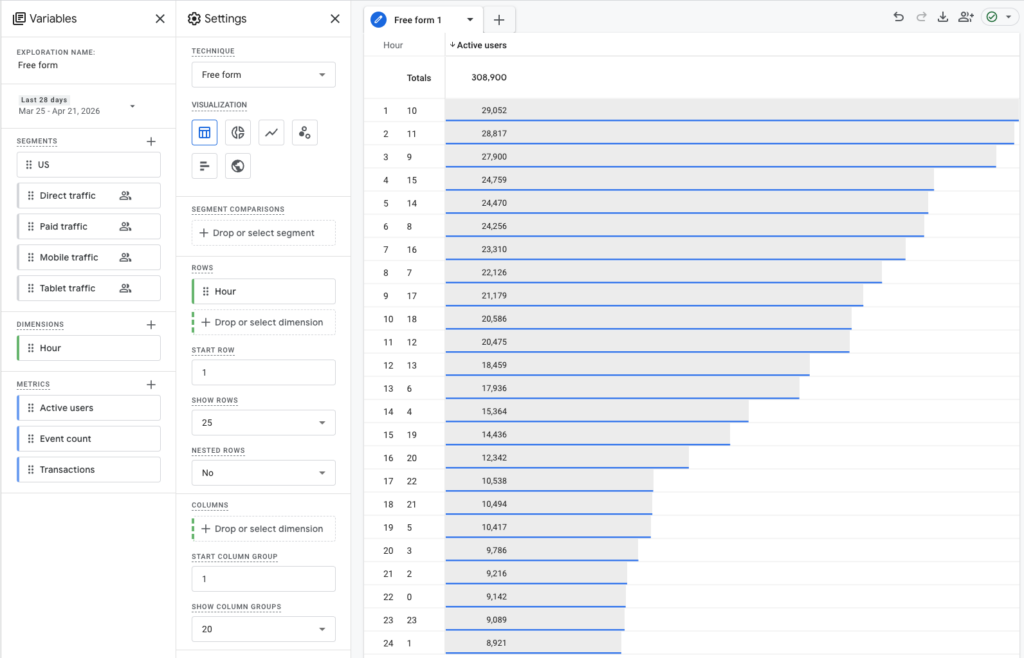
- Add the ‘Hour’ Dimension: In the Variables panel, locate and click the ‘+’ symbol next to "Dimensions." Search for "Hour." GA4 records website activity by hour, using a 24-hour format (0 for midnight, 23 for 11 PM). Drag this dimension into your rows. For more granular analysis, consider adding "Day + hour" to cross-reference activity by specific days of the week.
- Select a Relevant Metric: Next, add a metric to quantify user activity. "Sessions" provides a general overview of website visits, while "Engaged sessions" offers a more refined view of active, meaningful interactions. Drag your chosen metric into the values section. This will generate a report showing website sessions or engaged sessions broken down by the hour of the day.
- Interpret and Apply Data: Analyze the resulting chart or table to identify peak activity hours. For instance, if your GA4 data reveals the highest engaged sessions between 9 AM and 11 AM, this strongly suggests that 9 AM would be an optimal time to send an email, as your audience is demonstrably active and engaged with your content during that period. This process, typically taking less than 15 minutes, yields invaluable audience-specific data that far surpasses the utility of generalized industry benchmarks.
This methodology can be further enhanced by segmenting your GA4 data by geographic location, allowing you to ascertain peak activity times for different time zones within your audience. Similarly, examining traffic sources can provide insights into how users arrive at your site during different hours, helping to refine your email strategy for various subscriber segments.
Goal-Oriented Email Timing: Tailoring for Impact
The ‘best’ send time also varies significantly depending on the specific goal of the email campaign. A newsletter aiming for readership has different timing considerations than a promotional offer designed to drive immediate sales.
- Sales or Promotions:
- Timing: Early in the week (Tuesday/Wednesday) and mid-morning. Late afternoon, around 4:00 PM, has shown to drive stronger order rates for e-commerce-type sends in some studies, making it a valuable time to test for promotional campaigns. Avoid major promotions late Friday or Saturday afternoon unless your audience is heavily consumer-based and explicitly responsive during leisure hours.
- Rationale: These times align with peak productivity and decision-making windows, allowing recipients to act on offers before distractions or weekend plans take over. The 4 PM window can capture impulse purchases or those planning for evening activities.
- Event Reminders:
- Timing: Send the primary reminder 24-48 hours before the event. Follow up with a "last call" reminder one to two hours prior to the event start.
- Rationale: This cadence ensures the event stays top-of-mind without being intrusive. The final reminder capitalizes on immediate attention and the desire not to miss out.
- Newsletters or Educational Content:
- Timing: Tuesday or Thursday late morning consistently delivers the highest engagement for most lists.
- Rationale: These days and times typically coincide with periods of sustained focus and information consumption, allowing recipients to absorb longer-form content without feeling rushed. Content that adds value or provides insights performs well here.
For a comprehensive approach to email marketing best practices, including content creation, list segmentation, and automation, resources like AWeber’s email newsletter best practices guide offer deeper insights.
Continuous Improvement: Testing and Refinement
Finding your absolute best email send time is not a one-off task but an ongoing process of testing, analysis, and iteration. Audience behaviors can shift due to seasonal changes, holidays, global events, or even evolving work patterns.
- Leverage Your Analytics: Utilize the reporting features within your email service provider (e.g., AWeber’s reports) to track actual open rates, click-through rates, and conversions by send time. This is your most reliable feedback loop.
- Segment by Time Zone: For audiences spanning multiple geographic regions, implement time zone-aware scheduling. Sending an email at 10:00 AM local time for each segment dramatically increases relevance and engagement.
- Conduct A/B Tests: Design controlled experiments where you send the same email content to different, equally sized segments of your audience at varying times or on different days. Compare the results (open rates, click-throughs, conversions) to identify superior performance.
- Monitor and Iterate: Regularly review your campaign performance. If you observe shifts in engagement patterns, be prepared to adjust your sending schedule. For instance, weekend or holiday periods often necessitate unique timing strategies. Your audience’s actual habits should always override general benchmarks. If your data indicates a surge in opens at 8 PM, align your sends accordingly, even if it deviates from common advice.
Expert Insights and Broader Implications
Digital marketing strategists, including experts like Sean Tinney from AWeber, who possesses over 15 years of experience working with small businesses on email strategy, consistently emphasize the iterative nature of this process. They contend that while foundational data is useful, the true competitive advantage comes from personalized optimization. "The best time to send emails comes down to three things: know your audience, start with proven windows (midmorning on weekdays), and test your assumptions," Tinney notes. "Tuesday and Thursday mornings are the safest default. But the real answer lives in your own data. Use GA4 to find when your audience is active, then match your send schedule to that window. That’s when your emails get read."
The implications of optimized email timing extend beyond mere open rates. It directly impacts marketing ROI by ensuring that valuable content reaches its intended audience when they are most receptive, maximizing the chances of conversion. It fosters stronger customer relationships by demonstrating an understanding of their routine and respecting their inbox. From a brand perception standpoint, consistently delivering relevant messages at optimal times cultivates trust and positions the sender as a thoughtful and considerate communicator, rather than just another source of digital noise. For businesses navigating a crowded digital marketplace, mastering the art and science of email timing is not merely a tactical advantage but a strategic imperative for sustained engagement and growth.
Key Takeaways for Strategic Email Marketing
Ultimately, the journey to discovering the optimal email send time is a dynamic process rooted in a blend of industry insights and rigorous data analysis. While general guidelines such as midmorning weekdays, particularly Tuesday and Thursday, offer a reliable starting point, the definitive answer resides within the unique behavior patterns of your specific audience. Tools like Google Analytics 4 empower marketers to move beyond assumptions, providing actionable insights into when their subscribers are most active and receptive. By embracing a continuous cycle of testing, monitoring, and refinement, businesses can unlock the full potential of their email campaigns, ensuring their messages are not just sent, but truly seen, read, and acted upon. The strategic alignment of message delivery with recipient availability is the cornerstone of effective digital communication in the modern era.
- Sean Tinney is a content marketer at AWeber with 15+ years working directly with small business owners on email strategy, list building, and automation. He focuses on what actually moves the needle for businesses without large marketing teams. Connect with Sean on LinkedIn
- Sean Tinney